
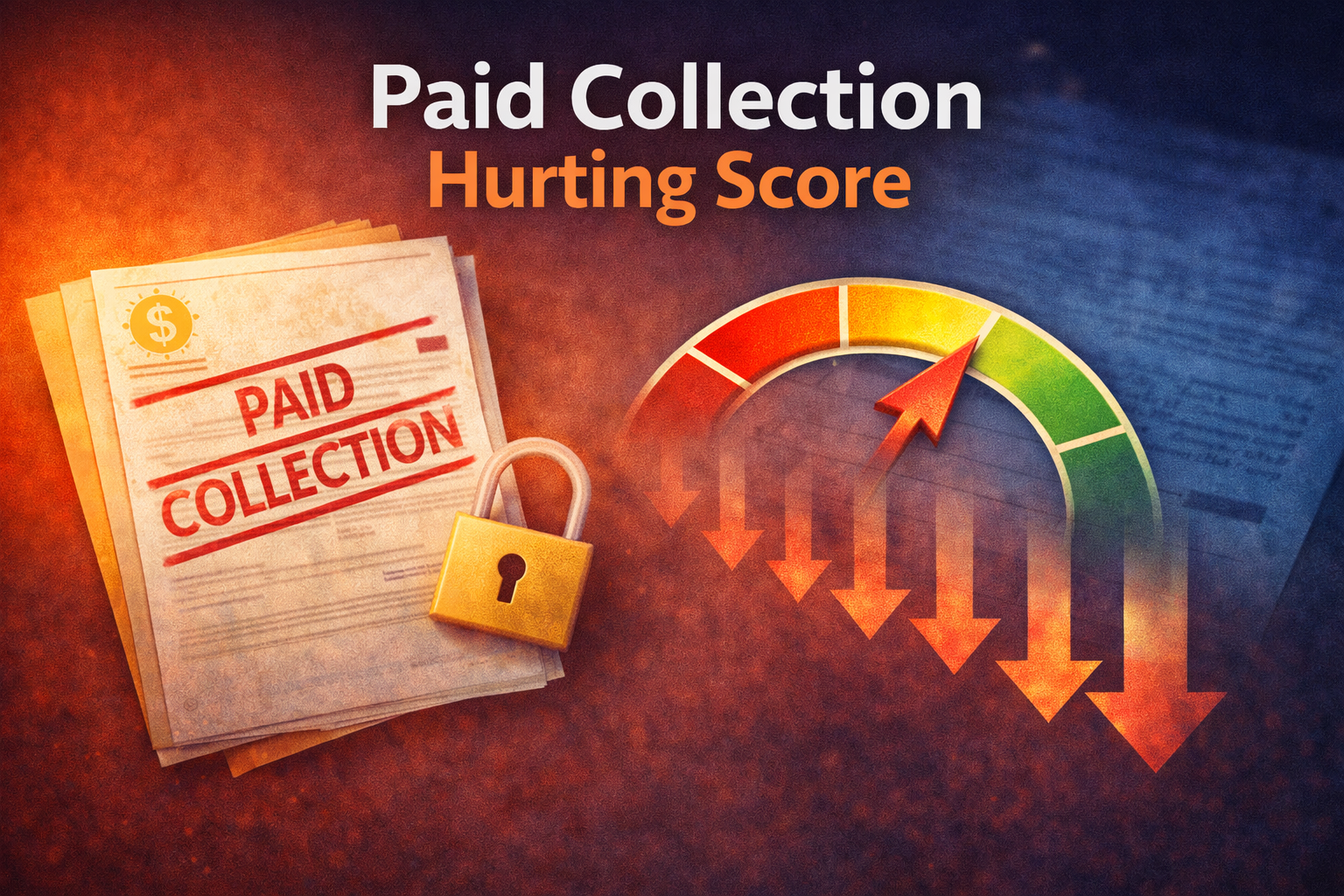
You paid off that collection account, did the right thing, and expected your credit score to bounce back. Instead, you’re staring at a number that barely moved—or worse, one that’s still taking a serious hit. This isn’t a glitch in the system, and you’re not imagining things. The truth behind paid collection hurting score is that paying a collection changes less than most people think, and understanding why requires looking at which credit scoring model your lender actually uses versus what you’re checking on your phone.
The gap between what “paid” means on paper and what it means to your score comes down to technical differences most consumers never hear about. Some scoring models treat paid collections exactly the same as unpaid ones. Others give you credit for resolving the debt, but the original delinquency still drags your score down for years. Even more frustrating, paid collections often contain reporting errors that keep them damaging your credit longer than they should. This guide on paid collection hurting score breaks down what actually changes when you pay a collection, which inaccuracies to look for, and the specific steps that can lead to removal or reduced impact on your score.
Why “Paid” Doesn’t Mean “Fixed”: The Scoring Model Split You Need to Understand
The credit scoring industry operates on multiple parallel systems, and the version your lender uses determines whether paying a collection improves your score at all. Paid collection hurting score is a common issue because FICO 8, released in 2009, remains the dominant model for credit card issuers and many lenders despite being nearly two decades old. This model treats paid collections identically to unpaid ones when calculating your score. The collection’s presence, regardless of payment status, triggers the same algorithmic penalty because FICO 8 interprets any collection as evidence of past payment failure. When you check your score through a credit monitoring app and see improvement after payment, you’re likely viewing VantageScore or FICO 9, neither of which most mortgage lenders or auto finance companies actually use for lending decisions. That mismatch is a major reason paid collection hurting score continues to confuse consumers.
FICO 9 and FICO 10, introduced to address the harshness of earlier models, exclude paid collections from score calculations entirely. These newer models recognize that consumers who resolve debts demonstrate financial responsibility, but their adoption has been slow and inconsistent across lending institutions. VantageScore similarly disregards paid collections, which explains why your Credit Karma score might jump 30 points after settling a debt while your mortgage application score remains unchanged. This scoring model split creates a dangerous illusion: you believe you’ve fixed your credit problem when the score that matters to your next lender hasn’t budged. This is exactly why paid collection hurting score remains such a frustrating problem. In many lending situations, paid collection hurting score depends less on the payment itself and more on which model the lender still uses.
The date of first delinquency—the month you initially fell behind with the original creditor—remains the anchor point for credit damage regardless of when or whether you paid the collection. This date determines both the seven-year reporting period and the score impact trajectory. Paying a collection three years after it was charged off doesn’t reset this clock or erase the delinquency history. Your credit report shows a timeline of missed payments leading to charge-off, then collection placement, and finally payment. Each of these events is a separate data point, and the payment notation doesn’t delete the preceding negative history that scoring algorithms weigh heavily. That timeline is another reason paid collection hurting score can last much longer than most people expect. Even after resolution, paid collection hurting score may continue because the original delinquency still anchors the damage.
The tradeline update from “unpaid collection” to “paid collection” modifies one field in your credit file but leaves the fundamental damage intact. Credit scoring models analyze multiple attributes of each tradeline: payment history, balance, account type, and age. Changing the status to “paid” addresses only one attribute while the delinquency pattern, collection designation, and negative account type remain. The algorithmic weight assigned to “this account went to collections” vastly exceeds any positive credit given for “this account was eventually paid.” This mathematical reality explains why your score’s response to payment feels disproportionately small compared to the effort and money you invested in resolving the debt. For many borrowers, paid collection hurting score feels unfair because the update looks positive but changes very little in practice. In scoring terms, paid collection hurting score often continues because the most damaging parts of the account remain on file.
Medical collections under $500 received special treatment starting in 2023 when the three major credit bureaus agreed to exclude them from credit reports entirely. This policy change created a specific exception for consumers with small medical debts, removing a category of collections that disproportionately affected people who experienced unexpected healthcare costs. However, this exception applies only to medical collections specifically, and only those under the $500 threshold. Other collection types—credit cards, personal loans, utility bills, and medical debts above $500—remain fully reportable and damaging whether paid or unpaid. If your paid collection falls outside this narrow medical exception, the broader scoring model dynamics still apply. That means paid collection hurting score is still a real issue for most non-medical debts. Unless the account qualifies for a specific reporting exception, paid collection hurting score may remain part of your credit reality for years.
How to Audit Your Collection Tradeline for Reporting Errors
The date of first delinquency frequently gets manipulated or reported incorrectly after collection accounts change hands, effectively restarting the seven-year reporting clock illegally. Paid collection hurting score problems often trace back to this issue. You need to compare the DOFD across all three credit bureaus and against your own records from the original creditor. Collection agencies sometimes report the date they purchased the debt or the date they first contacted you as the DOFD, which can add years to how long the collection damages your score. The Fair Credit Reporting Act requires that the DOFD reflect when you first fell behind with the original creditor, not any subsequent date. When you find discrepancies between bureaus or suspiciously recent dates for old debts, you’ve identified re-aging that violates federal law and provides grounds for deletion through dispute. In many cases, paid collection hurting score continues because the wrong delinquency date keeps the account active longer than it should.
Duplicate reporting multiplies the damage of a single debt when multiple collection agencies report the same obligation simultaneously. This occurs when the original creditor sells your debt to one agency, that agency later sells it to another, and both agencies continue reporting separate tradelines. Your credit report then shows two or three collection accounts for what is actually one debt, and scoring algorithms count each tradeline as a separate negative event. The impact on your FICO score isn’t linear—three collection tradelines don’t simply triple the damage of one, but they create a pattern that algorithms interpret as chronic payment failure rather than an isolated incident. You must trace the ownership chain by examining account numbers, original creditor names, and dates to identify which tradelines represent the same underlying debt. This is another major reason paid collection hurting score can stay worse than expected. When duplicate accounts exist, paid collection hurting score becomes more severe because the same debt appears multiple times.
Balance reporting errors create ongoing score damage even after you’ve paid a collection in full. Collection agencies sometimes fail to update the balance to zero after receiving payment, leaving your credit report showing an outstanding debt that doesn’t exist. Other times, settlements for less than the full amount get reported incorrectly, showing either the original balance or a partial payment that doesn’t match your settlement agreement. Each dollar of reported collection balance contributes to your credit utilization calculations in some scoring models and signals ongoing debt to lenders reviewing your report manually. You need to obtain your settlement letter or paid-in-full statement and compare the final balance shown on each bureau’s report. Discrepancies between your documentation and bureau reporting provide specific, provable errors for dispute. In situations like this, paid collection hurting score may have more to do with inaccurate balances than the collection itself. Fixing those errors can reduce the impact of paid collection hurting score much faster.
The ownership chain verification reveals whether the agency reporting your paid collection actually has the legal right to report it at all. Collection agencies must maintain documentation proving they own the debt or have authorization from the owner to report it. When debts are sold multiple times, this chain of title becomes murky, and agencies sometimes report debts they no longer own or never properly acquired. You can request validation of the reporting agency’s authority by demanding proof of ownership transfer and assignment documents. The absence of proper documentation means the agency is reporting information it cannot verify, which violates the accuracy requirements under FCRA and creates grounds for deletion. That makes ownership verification a key step when paid collection hurting score remains a problem after payment. In the end, paid collection hurting score often continues because inaccurate dates, duplicate tradelines, wrong balances, or weak ownership documentation have never been corrected.
Status code errors represent the most technically specific reporting mistakes that keep paid collections damaging scores unnecessarily. The Metro 2 format—the standardized system bureaus use to receive data from furnishers—includes specific codes for account status. A paid collection should show status codes indicating “paid” or “paid in full” depending on whether you settled or paid the entire amount. When these codes are wrong or missing, the account continues to appear as an active collection or unpaid debt. You need to review your credit report’s detailed tradeline information, which shows these codes, and compare them to what your payment agreement specified:
- Account Status Code: Should reflect “paid collection” (code 13) or “paid in full” (varies by bureau formatting)
- Payment Rating: Should show current or paid status, not “in collections”
- Balance: Must show $0 for paid-in-full accounts
- Remarks: Should include “paid” or “settled” notation with date
- Account Type: Remains as “collection” but payment status should be clear
Your Rights-Based Strategy to Remove Inaccurate Paid Collections
Debt validation requests remain a powerful tool even after you’ve paid a collection because validation addresses reporting accuracy, not just debt ownership. The Fair Credit Reporting Act requires that information on your credit report be accurate and verifiable, which means collection agencies must prove every detail they report—dates, amounts, ownership transfers, and payment status. You can send a validation request to the collection agency demanding documentation that supports their credit reporting, including the original creditor agreement, complete payment history, proof of their authorization to report, and evidence that all reported dates and amounts are accurate. Many agencies cannot produce comprehensive documentation, especially for older debts that have changed hands multiple times. When they fail to validate, you have grounds to dispute the tradeline with the bureaus as unverifiable.
Bureau disputes targeting specific inaccuracies succeed far more often than generic challenges to the debt’s validity. When paid collection hurting score remains a problem, you need to identify the precise errors in your audit—wrong DOFD, incorrect balance, missing paid status, duplicate reporting—and dispute those specific data points with documentation. A dispute stating “This collection account shows a balance of $1,247 but I paid it in full on January 15, 2025, as shown in the attached settlement letter” forces the bureau to investigate that specific claim. The bureau must contact the furnisher and verify the accuracy of the disputed information within 30 days. If the furnisher cannot verify the information as reported, or if they don’t respond to the bureau’s inquiry, the bureau must delete or correct the information. In many cases, paid collection hurting score continues only because vague disputes fail to address the exact reporting errors. Vague disputes claiming “not mine” or “inaccurate” without specifics get dismissed quickly because furnishers can simply verify that a collection exists without addressing the actual reporting errors.
Pay-for-delete agreements have become increasingly rare in 2026, particularly after payment has already occurred, but deletion through dispute of inaccurate information remains a viable path. For consumers dealing with paid collection hurting score, this means the best path is often a documentation-based dispute rather than a negotiated deletion request. Collection agencies historically offered pay-for-delete—agreeing to remove the tradeline in exchange for payment—but regulatory pressure and industry policies have made formal agreements uncommon. The original creditors often contractually prohibit collection agencies from deleting accurate information, and the major credit bureaus discourage the practice. However, this doesn’t eliminate your ability to secure deletion; it simply shifts the mechanism. When you dispute specific inaccuracies and the collection agency cannot verify the information as currently reported, deletion occurs through the dispute process rather than through a negotiated agreement. The outcome is identical, but the legal pathway differs, which is why paid collection hurting score can still be reduced when the reporting is inaccurate.
Goodwill deletion requests for paid collections succeed in specific circumstances that demonstrate your payment history with the original creditor was strong before the collection occurred. In some situations, paid collection hurting score can be reduced through a goodwill request when the collection resulted from a one-time hardship rather than a long-term pattern. These requests work best when you can document that the collection resulted from extenuating circumstances—medical emergency, job loss, divorce—rather than chronic payment problems. Your letter should address the original creditor rather than the collection agency, since creditors have more authority over reporting decisions. The language should acknowledge responsibility, explain the circumstances that led to the delinquency, emphasize your otherwise positive history with them, and request removal as a courtesy now that you’ve paid the debt. Success rates remain modest, typically below 30% based on industry observations, but the attempt costs nothing beyond the time to write a letter. Companies that value long-term customer relationships sometimes grant these requests, particularly for customers who had years of on-time payments before one collection incident. For that reason, paid collection hurting score does not always require a dispute if goodwill removal is realistic.
Escalation beyond initial bureau dispute responses becomes necessary when bureaus verify inaccurate information without properly investigating your specific claims. When paid collection hurting score continues despite clear proof of error, the Consumer Financial Protection Bureau complaint process creates a formal record and forces bureaus to provide detailed responses explaining their investigation. When you file a CFPB complaint, include all documentation—your dispute letters, bureau responses, proof of payment, and evidence of the specific inaccuracies. The bureau must respond to the CFPB within 15 days and address your complaint substantively. Furnisher direct disputes, sent to the collection agency itself rather than through the bureaus, invoke different legal obligations under FCRA Section 623. The furnisher must investigate and correct any inaccuracies they find, and if they determine their reporting was wrong, they must notify all three bureaus to update your file. Documentation of payment combined with clear evidence of reporting errors creates leverage because it demonstrates that the furnisher is violating accuracy requirements, exposing them to potential liability under FCRA. In the end, paid collection hurting score often persists only because consumers stop after the first failed dispute instead of escalating with stronger evidence.
How to Rebuild Your Credit While the Collection Remains
Score recovery timelines after paying a collection extend over months and years rather than days or weeks, even when the paid status updates correctly on your credit report. This is one reason paid collection hurting score remains such a frustrating issue for many consumers. The immediate impact of changing status from unpaid to paid produces minimal score improvement in FICO 8 and older models, typically between 0 and 10 points. The meaningful recovery occurs as the collection ages and other positive factors in your credit profile begin to outweigh it. Collections exert maximum damage in the first two years after placement, with their impact diminishing gradually as they approach the seven-year mark when they must be removed. A collection that’s six years old affects your score roughly 40-50% less than one that’s six months old, regardless of payment status. This aging process happens automatically, but it requires patience and continued positive credit behavior during the waiting period. For most people, paid collection hurting score is less about the payment itself and more about how long the account continues to age on the report.
The proportional impact principle means that identical paid collections damage different consumers’ scores by vastly different amounts depending on their overall credit profile. Someone with a 720 credit score and 15 years of positive history might drop 80-100 points from a single collection, while someone with a 500 score and multiple derogatory marks might drop only 20-30 points from the same collection. This counterintuitive dynamic occurs because scoring algorithms measure how much the collection deviates from your established pattern. The 720-score consumer has demonstrated consistent responsibility, so the collection represents a major departure that algorithms penalize heavily. The 500-score consumer already has multiple negative marks, so one additional collection adds less incremental damage. For consumers with thin credit files—those with few tradelines and short credit histories—a single collection can constitute 40-50% of their entire credit profile, making its impact disproportionately severe. That is why paid collection hurting score can feel far worse for someone with otherwise strong credit. In many thin-file situations, paid collection hurting score has an outsized impact because there are fewer positive accounts to offset it.
Adding positive tradelines strategically dilutes the collection’s weight in your overall credit profile by changing the ratio of negative to positive information. Each new account reporting on-time payments adds positive data points that scoring algorithms weigh against the collection. A secured credit card reporting 12 months of perfect payment history doesn’t erase the collection, but it demonstrates recent responsible behavior that algorithms value. The key is consistency rather than speed—one new secured card with six months of on-time payments improves your score more than three new cards opened simultaneously, which triggers multiple hard inquiries and lowers your average account age. Authorized user accounts on someone else’s well-managed credit card can add positive history to your file, though FICO 9 and newer models have reduced the weight given to authorized user status to combat manipulation. This is one of the most practical ways to reduce the impact of paid collection hurting score over time. A steady rebuild strategy works better than quick fixes when paid collection hurting score is tied to an older negative account.
Utilization optimization provides score improvement independent of the collection’s presence because utilization constitutes 30% of your FICO score. Keeping credit card balances below 10% of your credit limits—or ideally at zero by paying in full each month—maximizes this scoring factor. Many consumers focus exclusively on the collection while allowing utilization to creep up to 50-60%, which compounds their score problems. The mathematical impact of high utilization can exceed the collection’s damage in some cases, particularly as the collection ages. You should monitor utilization across all cards and total utilization across all cards combined, since scoring models evaluate both. Paying down balances strategically before your statement closing date ensures low utilization gets reported to the bureaus, providing score improvement even while the paid collection remains on your report. In other words, paid collection hurting score does not mean the collection is the only factor dragging you down. In many cases, lowering utilization is the fastest way to offset paid collection hurting score while waiting for the collection to lose impact naturally.
How to Prevent Paid Collections from Resurfacing on Your Credit Report
Paid collection hurting score is a problem that can continue months or years after payment and deletion due to debt portfolio sales, automated re-reporting systems, and errors in bureau dispute processing. Collection agencies frequently sell portfolios of accounts—including paid accounts—to other agencies or debt buyers who may attempt to report them as new tradelines. The purchasing agency’s systems automatically upload account data to the credit bureaus without checking whether the accounts were previously deleted following disputes. Additionally, when bureaus process disputes and delete information, their systems sometimes lack permanent flags preventing re-insertion. The original furnisher’s automated monthly reporting file continues to include the account, and bureau systems re-add it during the next reporting cycle. This creates a cycle where you successfully dispute and delete a paid collection only to find it reappearing three months later with the same or different reporting agency. That cycle is one reason paid collection hurting score remains such a frustrating issue for consumers.
Documentation of your payment serves as your primary defense against resurfaced collections and unauthorized re-reporting. When paid collection hurting score becomes an issue again, you need to maintain permanent records including the settlement agreement or paid-in-full letter on the collection agency’s letterhead, copies of canceled checks or bank statements showing the payment clearing, and any correspondence confirming the account’s resolution. When a paid collection reappears, this documentation proves the account should show paid status at minimum, and if it was previously deleted following a dispute, it demonstrates the re-insertion is erroneous. Many consumers discard these documents after seeing the collection removed from their reports, then lack proof when the account resurfaces years later. Digital copies stored in multiple locations—email, cloud storage, and physical files—ensure you can access proof regardless of how much time passes. Strong documentation can make a major difference when paid collection hurting score resurfaces after you thought the matter was resolved.
The risk of collection agencies selling paid accounts creates ongoing reporting threats because the new owner may not have complete payment information. When Agency A sells a portfolio of 10,000 accounts to Agency B, the data transfer often includes account numbers, original creditor information, and balance data, but payment status and dates may not transfer accurately. Agency B’s systems then report the accounts based on incomplete information, showing them as unpaid or with incorrect balances. The new agency has no relationship with you and may not have your payment records in their files. You must dispute the new agency’s reporting directly, providing your payment documentation and demanding they update or delete the tradeline. The new agency cannot legally report information they cannot verify, and if they lack proof of the unpaid balance they’re reporting, they must correct it. This is another way paid collection hurting score can continue even after the debt was legitimately resolved.
Ongoing monitoring specifically for the paid collection’s account number and original creditor name catches unauthorized re-reporting before it causes significant damage. Paid collection hurting score problems often get worse when consumers rely only on monitoring alerts that miss tradeline changes or the reappearance of deleted accounts. You need to review your actual credit reports from all three bureaus quarterly, searching specifically for the collection account number, original creditor name, and the collection agency that previously reported it. Setting calendar reminders ensures you don’t rely solely on automated alerts. When you catch re-reporting within 30 days, you can dispute it before it affects loan applications or credit decisions. Delayed discovery means the collection may have already damaged your score for months and appeared on reports that lenders pulled during that period. Staying proactive is one of the best ways to limit the long-term impact of paid collection hurting score.
Your legal recourse under FCRA when a verified paid and deleted collection is re-inserted without proper notice includes demanding re-investigation and potentially pursuing damages for willful non-compliance. Section 611(a)(5) of FCRA requires that when previously deleted information is re-inserted, the bureau must notify you within five business days and provide the name, address, and phone number of the furnisher who provided the information. If the bureau re-inserts the collection without this notice, they’ve violated FCRA. Additionally, if you can demonstrate that the re-insertion was willful—meaning the bureau knew or should have known the information was inaccurate based on your previous dispute—you may have grounds for statutory damages of $100 to $1,000 per violation, plus actual damages and attorney fees.
The Reality Behind the “Paid” Label: Your Path Forward
Paying a collection was the right move, but understanding why your score barely responded reveals the gap between expectation and credit scoring reality. The model your lender uses—likely FICO 8—treats paid collections identically to unpaid ones, while the apps showing improvement use newer versions most creditors ignore. The original delinquency date anchors seven years of damage regardless of payment status, and that timeline doesn’t reset when you settle the debt. Your score recovers through time and strategic credit building, not through the payment itself, though correcting reporting errors and disputing inaccuracies can accelerate removal. The documentation you kept, the specific errors you identified, and your persistence in challenging unverifiable information determine whether that paid collection disappears years early or continues dragging down every loan application until the seven-year mark. The system wasn’t designed to reward you for doing the right thing—it was designed to punish the initial mistake, and your job now is understanding which levers actually move your score while that collection ages into irrelevance.