

Opening your credit report to find a Credit One card, Fingerhut account, store card, or unauthorized credit account you never applied for creates an immediate problem. Your credit score can take a hit, you may be held responsible for charges you did not make, and you are left trying to figure out how this happened in the first place. These types of accounts can appear more often than many people realize, partly because some approval and verification processes prioritize speed over stronger identity checks, increasing the risk of an unauthorized credit account appearing on your report.
The good news is that you have specific legal rights under federal law that require creditors to prove the account actually belongs to you, not the other way around. But here is what most people do not realize: simply clicking “dispute” on a credit monitoring app rarely gets an unauthorized credit account or other inaccurate account removed. The process requires strategic documentation, an understanding of what triggers a creditor’s duty to investigate, and knowing which federal agencies can apply pressure when standard disputes fail. The question is not whether you can get this removed, but whether you are approaching it with the right evidence and timing to make removal inevitable.
Why These Store Cards Appear Without Your Knowledge—And Why They’re Particularly Vulnerable
Credit One, Fingerhut, and retail store cards operate in a fundamentally different underwriting environment than traditional bank-issued credit cards. These issuers target consumers with limited or damaged credit histories, which means their approval algorithms prioritize accessibility over stringent identity verification. The business model depends on high-volume approvals with elevated interest rates to offset default risk, creating a system where speed often trumps security. This architectural difference makes these accounts particularly susceptible to synthetic identity fraud, where criminals combine real and fabricated information to create seemingly legitimate credit profiles that slip through automated verification systems and result in an unauthorized credit account.
The data matching processes used by subprime and retail credit issuers frequently rely on fewer verification points than prime credit products. While a major bank might cross-reference multiple databases and require additional identity confirmation for inconsistencies, store card issuers often approve applications with minimal documentation—sometimes just a name, address, and Social Security number that appears valid in their system. This creates vulnerability at the matching stage, where algorithms may incorrectly link an application to your credit file and create an unauthorized credit account based on partial matches. When your name is common or you’ve recently moved to an address previously occupied by someone with a similar name, these matching errors become more likely. The system assumes the application belongs to your file because enough data points align, even though you never initiated the transaction, leaving you with an unauthorized credit account on your report.
Mixed file scenarios represent a documented pattern in credit reporting, particularly affecting consumers with thin credit files or those who share names with relatives. Store card issuers contribute disproportionately to these errors because their data furnishing practices often lack the sophisticated verification layers that larger financial institutions employ. You might discover a Fingerhut account or unauthorized credit account on your credit report that actually belongs to someone with your same first and last name who lived at your current address five years ago. The furnisher’s system merged this person’s account with your file because the name matched and the address had a historical connection to your credit profile, causing an unauthorized credit account to remain attached to your history. These errors persist because the initial data submission goes unchallenged, and subsequent automated updates continue reporting the account to your file without triggering any verification flags.
Pre-approved credit offers create another vulnerability specific to store cards. These offers arrive by mail based on pre-screening criteria, and fraudsters who intercept them can complete applications using the recipient’s basic information without needing to bypass additional security measures. The unauthorized credit account may show as “opened by consumer request” in your credit file because the application technically used a legitimate pre-screened offer code. This makes the unauthorized credit account appear more legitimate to credit bureaus during disputes, since the furnisher can point to a valid offer acceptance rather than a completely fabricated application. The distinction matters because it affects how aggressively the furnisher defends the account’s validity during your dispute process.
Your 72-Hour Documentation Protocol: Building an Undisputable Evidence File
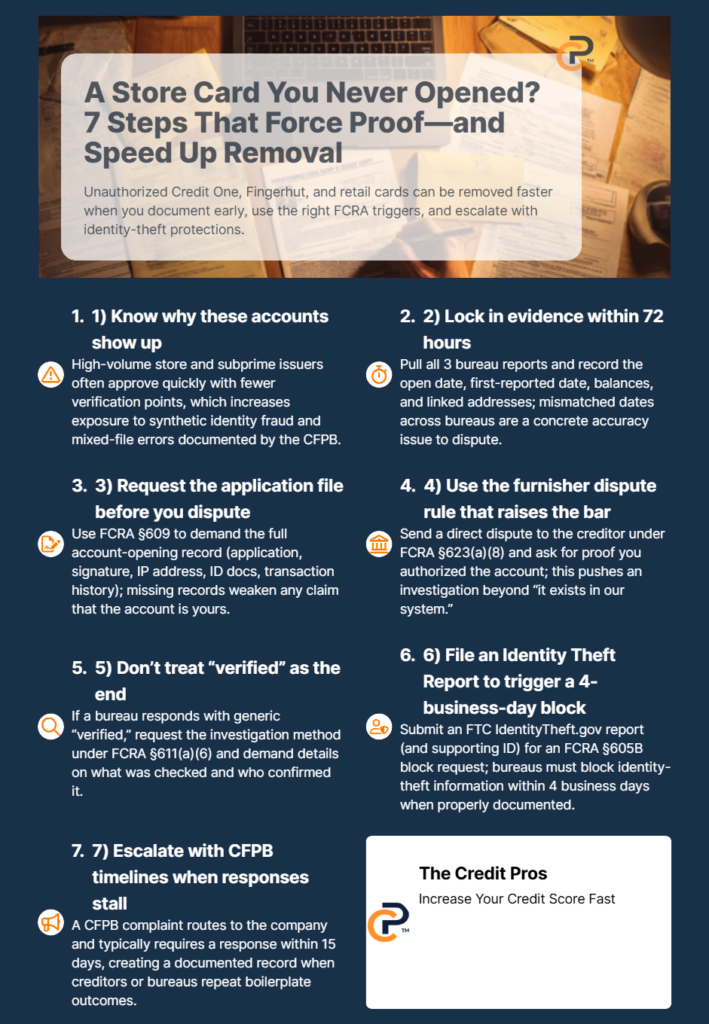
The first 72 hours after discovering an unauthorized credit account determine the strength of your entire removal case. You need to pull your complete credit reports from all three bureaus—Experian, Equifax, and TransUnion—because each may contain different details about the fraudulent tradeline. The account number format, original creditor designation, and reporting dates often vary between bureaus, and these discrepancies become evidence of reporting inconsistencies. Document the exact date the account was opened, the date it first appeared on each bureau’s report, when the first payment was allegedly due, and when payment history begins. Gaps or inconsistencies in these timelines can strengthen your dispute and support removal of an unauthorized credit account.
Extracting every available detail from each bureau report requires looking beyond the summary information. Note whether the unauthorized credit account shows as “individual” or “joint,” the credit limit or original loan amount, the terms of the account, and any associated addresses. Compare these details across all three reports. If Experian shows the account opened on March 15, 2024, but Equifax lists March 20, 2024, you’ve identified a verification problem—the furnisher cannot accurately report basic account facts. If the address associated with the unauthorized credit account doesn’t match any address in your legitimate credit history, document this immediately. These specific data points matter because they demonstrate that the furnisher lacks reliable information about the account’s origin.
Before filing formal disputes with credit bureaus, consider sending a direct request to the furnisher under FCRA Section 609(a)(1)(A), which grants you the right to access information in your file. If the issue involves an unauthorized credit account, request the complete application file, including the original application with signature, the IP address from which any online application was submitted, and all transaction records from the account opening date forward. Ask for copies of any identity verification documents submitted with the application. This pre-dispute request serves two purposes: it forces the furnisher to search their records before they’re under investigation pressure, and their response (or lack of response) becomes evidence in your subsequent dispute involving the unauthorized credit account. Many store card issuers cannot produce these documents because their records retention policies don’t preserve application details beyond certain timeframes, or because the application was fraudulent and no legitimate documentation exists.
Creating a counter-timeline of your legitimate financial activity on the date the unauthorized credit account was allegedly opened provides powerful supporting evidence. Pull your bank statements, legitimate credit card statements, and any other financial records that show your location and activities during that period. If you were making purchases in California on the day a Fingerhut account was supposedly opened using a New York IP address, this geographical impossibility supports your claim. If you already had three store cards with higher limits than the fraudulent account, this demonstrates you had no logical reason to open another retail credit line. Document any major life events during that period—a hospital stay, a business trip with travel receipts, or a home closing with dated paperwork—that would have made opening a new credit account unlikely or impossible.
The decision between placing a fraud alert versus implementing a credit freeze affects your dispute strategy more than most consumers realize. An initial fraud alert, which lasts one year and requires creditors to take additional verification steps, allows you to continue accessing your credit while signaling to bureaus that identity theft has occurred. This access matters if you need to pull detailed reports or if potential creditors need to verify information during your dispute process. A security freeze locks your credit entirely, preventing new account openings but also complicating legitimate credit activities. For dispute purposes, start with a fraud alert to maintain investigation flexibility, then escalate to a freeze only if you discover multiple fraudulent accounts or ongoing fraud attempts. The fraud alert alone triggers additional scrutiny of the unauthorized credit account during bureau investigations.
The combination of bureau discrepancies, missing verification records, and your supporting evidence can make it much harder for a furnisher to validate an unauthorized credit account as accurate.
The Three-Tier Dispute Architecture: Bureau, Furnisher, and Validation Requests
Disputing an unauthorized credit account simultaneously with all three credit bureaus might seem efficient, but this approach frequently backfires. When you file identical disputes with Experian, Equifax, and TransUnion at the same time, the bureaus often contact the same furnisher verification department. The furnisher provides one response, and all three bureaus mark the unauthorized credit account as “verified” based on that single investigation. This coordinated response makes subsequent disputes harder because each bureau points to the other bureaus’ verification as additional confirmation. Instead, stagger your disputes strategically—start with the bureau showing the most account detail or the earliest reporting date, then use their response to refine your approach with the remaining bureaus.
Direct furnisher disputes represent your primary leverage point because FCRA Section 623(a)(8) imposes heightened investigation duties on creditors when consumers dispute accounts directly with them. Your dispute letter to Credit One, Fingerhut, or the store card issuer should explicitly invoke this section and request specific documentation that proves the unauthorized credit account is legitimate. Demand the original application with your signature, verification of the IP address used for any online application, copies of any identity documents submitted, and complete transaction history from the account opening date. Request details about the verification process used when the unauthorized credit account was opened—what databases were checked, what identity confirmation steps were taken, and what documentation the applicant provided. This level of specificity forces the furnisher to conduct a substantive investigation rather than simply confirming that an account exists in their system.
The debt validation demand strategy works differently than a credit bureau dispute because it triggers the furnisher’s obligation to provide “reasonable verification” of the unauthorized credit account and its legitimacy. This addresses whether they can prove you authorized it, not whether the account exists in their system. Your letter should clearly state that you’re requesting validation of the debt and verification of your authorization to open the unauthorized credit account. Specify that you’re not requesting verification that an account exists under your name, but rather proof that you personally applied for and authorized this credit line. This distinction matters because many furnishers respond to disputes by simply confirming that their records show an account, without actually verifying the legitimacy of the account’s origin. By explicitly requesting authorization proof, you narrow the scope of acceptable verification.
Your documentation package should include multiple forms of supporting evidence that create a comprehensive picture of the fraud. A police report filed for identity theft carries significant weight because it creates an official record of the crime and demonstrates you’re treating the unauthorized credit account as fraud rather than a simple error. IRS Form 14039, the Identity Theft Affidavit, provides federal documentation of the theft and triggers additional protections. A notarized statement detailing your non-authorization of the account, including specific facts about when you discovered it and why you know you didn’t open it, creates sworn testimony. Include address history verification from your legitimate credit accounts or utility bills showing you never lived at any address associated with the account. Organize these documents with a cover letter that references each piece of evidence and explains its relevance to your dispute.
When “Verified” Doesn’t Mean Verified: Challenging Inadequate Investigations
The response letter you receive from a credit bureau after disputing an unauthorized credit account reveals whether they conducted a meaningful investigation or merely rubber-stamped the furnisher’s verification. Generic language like “we have verified this information with the creditor” or “the creditor has confirmed this account belongs to you” indicates a superficial review. A substantive investigation response includes specific details about what verification steps were taken, what documentation the furnisher provided, and what specific information was confirmed. When the bureau’s letter lacks these details and simply states the account was “verified,” you’re looking at an inadequate investigation that violated FCRA Section 611(a)(1)(A)’s requirement for reasonable investigation procedures.
The absence of investigation method disclosure in the bureau’s response creates your opening for escalation. FCRA Section 611(a)(6) requires bureaus to provide you with a description of the investigation procedure upon request. Your reinvestigation demand should explicitly cite this section and request detailed information about how they verified the unauthorized credit account. Ask which furnisher representative they contacted, what specific questions were asked, what documentation the furnisher provided, and what criteria they used to determine the account was valid. Request the actual verification documents the furnisher supplied, not just the bureau’s summary of those documents. Most bureaus cannot or will not provide this level of detail because their investigation consisted of an automated inquiry to the furnisher’s database rather than a meaningful review of authorization evidence related to the unauthorized credit account.
Store card issuers frequently cannot produce application documentation from accounts older than certain retention periods. Credit One and Fingerhut, like many high-volume credit issuers, may only retain detailed application records for five to seven years before archiving or destroying them. If your unauthorized credit account is older, the furnisher may be unable to provide the signature verification, IP address logs, or identity documents you requested. This records retention failure becomes your leverage point—if the furnisher cannot produce evidence that you authorized the account, they cannot reasonably verify its legitimacy. Your escalated dispute should explicitly state that without production of authorization documents, the furnisher has failed to meet their verification obligations under the FCRA, and the unauthorized credit account must be deleted as unverifiable.
Filing a CFPB complaint creates regulatory pressure that often produces faster and more thorough creditor responses than standard dispute letters. The Consumer Financial Protection Bureau forwards complaints to creditors and requires responses within 15 days, and these complaints become part of the company’s regulatory record. Time your CFPB complaint strategically—file after you’ve given the furnisher adequate opportunity to respond to your direct dispute, typically 30 to 45 days, but before you’ve exhausted all dispute attempts. Select complaint categories that trigger heightened scrutiny, such as “Incorrect information on your report” combined with “Information belongs to someone else” for an unauthorized credit account, or “Improper use of your report” if the unauthorized credit account resulted from identity theft. Include copies of your dispute letters and the inadequate responses in your complaint submission, creating a documented trail of the furnisher’s failure to properly investigate.
Escalation and Legal Leverage: Identity Theft Reports, FCRA Compliance, and Professional Dispute Management
The FTC Identity Theft Report filed at IdentityTheft.gov creates a legal record that fundamentally shifts the burden of proof in your dispute. This report, combined with a police report, generates an Identity Theft Report under federal law that triggers specific creditor obligations under FCRA Section 605B. Once you’ve filed this report, you’re asserting identity theft rather than simply disputing an account error, which requires creditors and bureaus to treat the situation with heightened seriousness. The FTC report includes a detailed affidavit of the fraudulent accounts and activities, creating sworn testimony that carries weight in subsequent disputes. This documentation becomes particularly important if the furnisher continues reporting the account after you’ve provided identity theft evidence.
The identity theft block request process operates under different rules and timelines than standard disputes, offering a faster removal path for confirmed fraud. Under FCRA Section 605B, you can submit a block request to each credit bureau along with your Identity Theft Report and proof of identity. The bureaus have four business days to block the fraudulent information from appearing on your credit report. This expedited timeline bypasses the standard 30-day investigation period because you’re not asking the bureau to investigate whether the account is yours—you’re providing legal documentation that it resulted from identity theft and must be blocked. Your block request should include the FTC Identity Theft Report, a government-issued ID, proof of address, and a letter identifying the specific tradeline to be blocked with as much detail as possible (account number, creditor name, date opened, balance).
Understanding when DIY disputes reach diminishing returns requires honest assessment of your situation’s complexity and the responses you’re receiving. If you’ve sent detailed dispute letters to the furnisher with comprehensive documentation, filed bureau disputes with supporting evidence, and submitted a CFPB complaint, yet the account remains on your report with generic “verified” responses, you’re facing institutional resistance that may require professional intervention. Mixed file situations involving multiple consumers’ information merged into your report, cases with several unauthorized accounts from different creditors, or situations where furnishers simply ignore your disputes entirely represent scenarios where professional credit dispute services provide value. These services understand the specific pressure points in the dispute process, have established relationships with creditor verification departments, and know which escalation tactics produce results when standard approaches fail.
Ongoing monitoring after successfully removing an unauthorized store card protects against re-reporting and new fraud attempts. Set up automatic alerts with all three credit bureaus for new account inquiries, which signal someone attempting to open credit in your name. Many consumers assume that once an unauthorized account is removed, the issue is resolved, but furnishers sometimes re-report deleted accounts if they receive updated information or if their systems flag the account for routine reporting. Quarterly manual reviews of your complete credit reports catch these re-insertions before they age on your report. Maintain your fraud documentation file—including dispute letters, responses, the FTC Identity Theft Report, and police reports—for at least seven years. If the unauthorized account reappears, you’ll need this documentation to quickly re-dispute and prove you’ve already established the account as fraudulent. This prevention architecture ensures the work you’ve done to remove the fraudulent tradeline produces lasting results rather than temporary relief.
Wrapping Up: Making Removal Inevitable Through Strategic Documentation
Removing an unauthorized Credit One, Fingerhut, or store card isn’t about hoping creditors do the right thing—it’s about understanding that these accounts exist in a verification environment built for speed over security, making them particularly vulnerable to documented challenges. The question posed at the beginning wasn’t whether removal is possible, but whether you’re approaching it correctly. The answer lies in strategic documentation that shifts the burden of proof, staggered disputes that prevent coordinated resistance, and escalation through federal channels when furnishers provide inadequate responses. Your legal rights under the FCRA don’t activate automatically; they require precise invocation with supporting evidence that makes continued reporting legally untenable for the furnisher.
The real power in this process isn’t found in generic dispute buttons on credit monitoring apps—it’s in understanding that creditors can’t verify what they can’t prove, and most store card issuers can’t produce authorization documents that don’t exist. When you’ve built an undisputable evidence file and the furnisher still reports the account as verified without providing the documentation you’ve requested, you’re no longer dealing with a credit reporting issue—you’re documenting a potential FCRA violation that exposes them to statutory damages of up to $1,000 per violation, plus actual damages and attorney fees.