


A single debt appearing twice on your credit report can drop your score by 50 to 100 points—and most people never realize it’s happening. The damage isn’t just about the numbers on your report. Those duplicate entries can cost you thousands in higher interest rates on mortgages and auto loans, or worse, lead to denied applications for credit cards and housing. The frustrating part? These duplicates often look completely different at first glance, with varied account numbers, different collection agency names, and mismatched balances that make them seem like separate obligations. That’s why learning how to remove duplicate debts is so important if you want to protect your credit profile.
What makes duplicate debt reporting so common? When your original debt changes hands—sold from one collection agency to another, or transferred during portfolio sales—each entity in that chain can report it as if it’s a brand new account. The credit bureaus don’t always catch these overlaps, especially when there are slight variations in how your information appears. You’re about to learn exactly how to spot these hidden duplicates, build an undeniable case for their removal, and remove duplicate debts before they continue dragging down your score. With the right dispute strategy and documentation, you can remove duplicate debts and keep them from reappearing once you’ve cleaned up your report.
How Your Account Gets Counted Twice: The Mechanics Behind Duplicate Debt Reporting
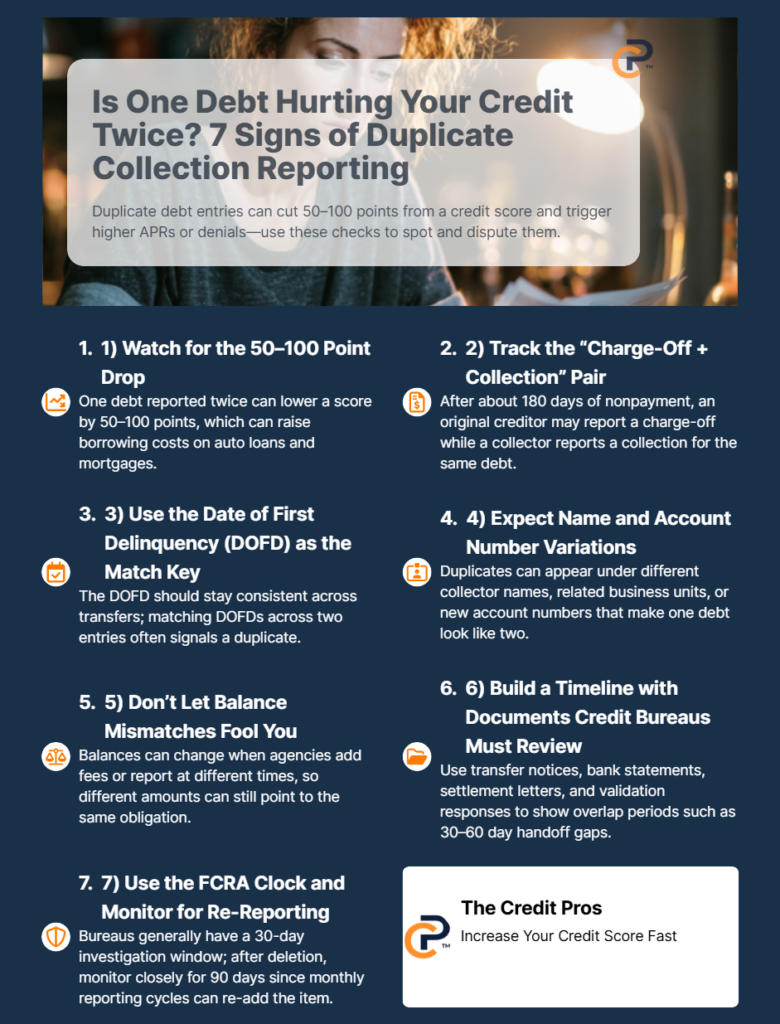
The journey of a debt through the financial system resembles a game of telephone, where each handoff creates an opportunity for duplication. When your original creditor determines an account is uncollectible—typically after 180 days of non-payment—they sell that debt to a collection agency for pennies on the dollar. This first transaction initiates a reporting chain where both the original creditor and the new collection agency may simultaneously report the same obligation to the credit bureaus. The original creditor reports it as a charged-off account, while the collection agency reports it as a new collection account, despite both entries representing the identical debt. Understanding this chain is the first step if you want to remove duplicate debts from your credit report.

The complexity intensifies when collection agencies engage in portfolio trading. A collection agency that purchases your debt might hold it for six months before selling it to another agency, which then sells it to yet another. Each entity in this chain believes they have the right to report the debt to credit bureaus, treating their acquisition as a new account worthy of separate reporting. The credit bureaus receive these reports and, without sophisticated matching algorithms that account for all variations, create distinct entries for what is fundamentally the same financial obligation. The Fair Credit Reporting Act doesn’t explicitly prohibit multiple entities from reporting the same debt, but this practice creates a multiplicative effect on your credit damage that far exceeds the impact of a single delinquent account. To remove duplicate debts, you need to identify every agency in the chain and compare how each tradeline is reported.
The timing gap between debt sales creates a particularly insidious form of duplication. When Collection Agency A sells your debt to Collection Agency B, there’s typically a 30 to 60-day lag before Agency A updates the credit bureaus to reflect that they no longer own the account. During this window, both agencies report the debt simultaneously. Agency A shows an outstanding balance, while Agency B reports a new collection with a recent opening date. Even after Agency A updates their reporting to show a zero balance or transferred status, the historical reporting from both agencies remains on your credit report, creating a documented trail that makes it appear you had two separate collection accounts during that overlap period. This is exactly why consumers must document timelines carefully to remove duplicate debts successfully.
The zombie debt phenomenon represents one of the most frustrating aspects of duplicate reporting. You settle a debt with a collection agency, make your final payment, and receive confirmation that the account is closed. Months or even years later, that same debt appears on your credit report under a different collection agency’s name. What happened? The original collection agency sold their portfolio—including settled accounts—to a debt buyer who either wasn’t informed of the settlement or chose to report it anyway. These secondary and tertiary purchasers often acquire debts in bulk with incomplete documentation, leading them to report accounts as active collections even when they’ve been resolved. The credit bureaus, seeing a new creditor name and account number, treat this as a fresh entry rather than recognizing it as a duplicate of the settled debt. If you want to remove duplicate debts in these cases, payment records and settlement letters become your strongest evidence.
Credit bureau merge errors add another layer of complexity to the duplicate tradelines problem. The bureaus use matching algorithms that rely on personal identifiers like your name, Social Security number, address, and date of birth. When there are slight variations in how this information appears—perhaps your name is listed as “John A. Smith” on one account and “John Smith” on another, or an old address appears on one report—the bureau’s system may fail to recognize that both accounts belong to the same person and the same debt. Instead of consolidating the information under a single entry, the system creates two separate tradelines. This technical glitch becomes particularly problematic when debt collectors purchase information from multiple sources, each with slightly different versions of your personal data. To remove duplicate debts, you need to dispute the inaccurate tradelines using matching account details, balances, and delinquency dates.
Once you understand how these duplicates are created—through charge-offs, portfolio sales, timing gaps, zombie debt resales, and bureau merge errors—you can build a stronger dispute strategy. The goal is not just to challenge one entry, but to prove that multiple tradelines are tied to the same underlying obligation so the bureaus can remove duplicate debts correctly. With the right documentation, persistence, and follow-up, you can remove duplicate debts and prevent the same account from continuing to harm your credit score.
Identifying Duplicate Debts Hidden in Plain Sight: The Forensic Audit
Obvious duplicates—those with identical creditor names, matching balances, and the same account numbers—represent only a fraction of duplicate debt reporting. The more challenging duplicates disguise themselves through variations that make them appear as separate obligations. A debt might show as $1,847 from “Midland Credit Management” and $1,950 from “MCM Portfolio Services,” with different account numbers and dates opened six months apart. To the untrained eye, these appear as two distinct debts, but they’re often the same obligation reported at different stages of the collection process or by related corporate entities operating under different business names. Learning to spot these patterns is essential if you want to remove duplicate debts effectively.
The date of first delinquency serves as the most reliable fingerprint for matching duplicate accounts. This date represents when you first fell behind on the original account and never caught up—the point of no return that triggered the eventual charge-off. Federal law requires that this date remain consistent regardless of how many times the debt is sold or transferred. When you examine your credit report and find two collection accounts with identical dates of first delinquency but different creditor names and account numbers, you’ve likely uncovered a duplicate. The DOFD acts as an immutable marker that survives all transfers, making it the single most important data point in your duplicate detection work and helping you remove duplicate debts with stronger evidence.
Creditor name variations present a significant challenge in the bureau investigation process. Collection agencies often operate multiple divisions under different names, or they rebrand entirely while maintaining the same corporate structure. “Portfolio Recovery Associates,” “PRA Group,” and “PRA Receivables Management” might all appear on your report, and without understanding their corporate relationships, you wouldn’t know they’re connected entities potentially reporting the same debt. Additionally, collection agencies frequently use generic business names that provide no indication of their relationship to other entries. Your investigation requires researching each creditor name through state business registries and corporate filings to identify these hidden connections before you can remove duplicate debts accurately.
Balance discrepancies between suspected duplicates often mislead consumers into thinking they’re dealing with separate debts. A debt sold from one collection agency to another rarely transfers at the exact same amount. The first agency might have added collection fees, interest, or administrative charges, bringing a $2,000 original debt to $2,340. When they sell it, the purchasing agency might report the debt at the purchase price—perhaps $2,200—or they might add their own fees, pushing it to $2,575. These varying amounts, when viewed in isolation, suggest different obligations. However, when you trace the timeline and examine the dates of first delinquency, the connection becomes clear. The balance variations actually strengthen your duplicate claim because they demonstrate the same debt moving through different hands, each adding their own charges. This is the kind of pattern you can use to remove duplicate debts through a well-documented dispute.
Your personal financial records provide the roadmap for identifying duplicates that credit reports alone cannot reveal. Bank statements showing when you made payments, to whom, and for what amounts create a chronological narrative of your debt history. If you made a $200 payment to ABC Collections in March 2024, but your credit report shows both ABC Collections and XYZ Recovery Services reporting collection accounts with March 2024 activity, your bank statement proves you only made one payment. Original creditor statements, payment receipts, and even email confirmations serve as external validation that contradicts the multiple-debt narrative your credit report suggests. This documentation becomes particularly valuable when collection agencies claim their entries are separate because they purchased “different tranches” of your debt—a common deflection tactic when confronted with duplicate reporting.
Once you connect these clues—matching DOFDs, related creditor names, shifting balances, and payment records—you can build a dispute package that makes it much harder for bureaus to ignore your case. The stronger and more organized your evidence, the easier it becomes to remove duplicate debts without getting stuck in repeated investigations. In many cases, consumers who systematically compare all tradeline details can remove duplicate debts faster than those who only focus on account numbers, because duplicates rarely match perfectly line by line.
Building Your Dispute Case: Documentation Strategies Credit Bureaus Cannot Ignore
The foundation of an undeniable dispute case starts with reconstructing your account timeline from inception to current status. This chronological paper trail begins with the original creditor statement showing when the account first became delinquent, followed by charge-off notices, debt sale notifications, and each subsequent collection letter. Your timeline should document every entity that has claimed ownership of the debt, the dates they began reporting, and any payments or settlements made along the way. This reconstruction exposes the gaps and overlaps in reporting that prove duplication and helps you remove duplicate debts with a clear evidence trail. When you can show that Collection Agency A reported the debt from January through June, and Collection Agency B began reporting the same debt in May—creating a two-month overlap—you’ve provided visual proof of duplicate reporting that’s difficult for credit bureaus to dismiss.
The Metro 2 format represents the standardized reporting structure that creditors and collection agencies use to submit information to credit bureaus. Understanding this format’s required fields reveals weaknesses you can exploit in your dispute. Each Metro 2 submission must include specific data points: account number, balance, payment status, date opened, and date of first delinquency. When duplicate accounts show inconsistencies in these mandatory fields—particularly the DOFD—you’ve identified a reporting violation. If one entry shows a DOFD of March 15, 2023, and the suspected duplicate shows April 20, 2023, at least one of these entries violates reporting standards. Your dispute should explicitly reference these Metro 2 inconsistencies, demonstrating that you understand the technical requirements and that the creditor has failed to meet them, which can strengthen your case to remove duplicate debts.
Debt validation requests to collection agencies create a powerful foundation for your credit bureau disputes. The Fair Debt Collection Practices Act requires collection agencies to provide verification of the debt when requested within 30 days of their initial contact. Your validation request should specifically ask for documentation proving they own the debt, the original creditor’s name and account number, the amount owed, and a complete payment history. When you send these requests to multiple agencies reporting what you suspect are duplicates, their responses—or lack thereof—provide critical evidence that can help remove duplicate debts. If Agency A provides documentation showing they purchased the debt from Original Creditor on June 1, 2024, and Agency B’s documentation shows they purchased the same debt on June 15, 2024, you’ve proven that the debt was sold twice in rapid succession, creating duplicate reporting. Even better, if one agency fails to respond or provides incomplete information, you can use that failure as additional evidence in your bureau dispute and further support your effort to remove duplicate debts.
Proof of payment or settlement documentation becomes your strongest weapon against duplicate debt reporting when you need to remove duplicate debts after a balance has already been resolved. If you settled a debt with one collection agency and have the settlement letter, canceled check, or bank statement proving final payment, any subsequent reporting of that debt by another agency is clearly a duplicate. Your dispute package should include copies of the settlement agreement showing the terms, proof of payment, and the original agency’s confirmation that the account was closed. When a new collection agency appears on your report claiming you owe the same debt, your documentation proves they’re either reporting a debt that was already resolved or they’re duplicating an existing entry. Credit bureaus must investigate this discrepancy, and the presence of settlement documentation makes it nearly impossible for them to verify the duplicate as accurate, making it much easier to remove duplicate debts.
Creditor correspondence provides the paper trail that connects seemingly unrelated accounts. When a debt is sold, creditors are required to notify you of the transfer, including the name of the purchasing agency and the date of transfer. These transfer notifications serve as timestamps that prove when one agency stopped owning the debt and another began. If your credit report shows both agencies reporting the debt after the transfer date, you have documentary proof of duplication. Request account closure letters from agencies that claim they’ve transferred your debt, and demand transfer documentation from agencies claiming they’ve purchased it. This correspondence creates an unbroken chain of custody that either proves your debt was legitimately transferred (supporting a duplicate claim) or reveals that multiple agencies are reporting the same debt without proper ownership documentation (an even stronger dispute position), giving you the documentation needed to remove duplicate debts and keep them from resurfacing.
Navigating the Three-Bureau Challenge with Precision: The Dispute Execution
Each credit bureau—Experian, Equifax, and TransUnion—operates with distinct verification processes that require tailored dispute approaches. Experian tends to be more receptive to online disputes with attached documentation, allowing you to upload supporting files directly through their dispute portal, which can help you remove duplicate debts more efficiently. Equifax historically responds better to disputes that specifically cite Fair Credit Reporting Act violations and include detailed explanations of why the duplicate reporting violates federal law, especially when your goal is to remove duplicate debts through a stronger legal argument. TransUnion often requires the most documentation upfront, and their verification process involves more direct contact with the furnishing creditor, so you’ll usually need a more complete file to remove duplicate debts successfully. Your dispute strategy must account for these differences, potentially using online submission for Experian, certified mail with FCRA citations for Equifax, and comprehensive documentation packages for TransUnion to remove duplicate debts across all three reports.
The escalation pathway for credit report cleanup follows a strategic progression based on bureau responses. Initial disputes should be concise, clearly identifying the duplicate accounts and providing core evidence like matching dates of first delinquency and creditor transfer documentation. If the bureau responds by verifying the duplicate as accurate, your escalation involves submitting additional evidence you held in reserve—payment records, validation responses from collection agencies, or correspondence proving the accounts are identical. When bureaus continue to verify duplicates despite overwhelming evidence, your next escalation invokes specific FCRA violations, citing Section 611(a)(1)(A) which requires reasonable investigation, and threatening to file complaints with the Consumer Financial Protection Bureau. This escalation demonstrates that you understand your rights and are prepared to take formal action to remove duplicate debts beyond the standard dispute process.
The tactical decision between simultaneous and sequential disputes depends on your specific situation and risk tolerance. Disputing with all three bureaus simultaneously creates pressure on the furnishing creditor, who must respond to multiple investigations at once. This approach works well when you have strong documentation and the duplicates are obvious—the creditor, facing three separate verifications, may simply delete the duplicate rather than invest resources in defending it across multiple bureaus. However, sequential disputes offer advantages when your case is more complex. By disputing with one bureau first, you learn how the creditor responds to the investigation, what arguments they make, and what additional documentation they provide. You can then refine your approach for the second and third bureaus, addressing the creditor’s defenses preemptively and strengthening your evidence based on what you learned from the first dispute outcome. Choosing the right approach can make it much easier to remove duplicate debts without unnecessary delays.
Credit bureaus sometimes designate disputes as “frivolous” when they believe you’re repeatedly disputing the same item without providing new information. This designation allows them to refuse investigation, effectively blocking your dispute rights. When you receive a frivolous dispute designation, your response must demonstrate that you’re providing new evidence or raising different legal arguments. Reframe your dispute by focusing on different aspects of the duplication—if your first dispute highlighted matching balances, your second should emphasize identical dates of first delinquency and creditor transfer documentation. Include a cover letter explicitly stating that you’re providing new evidence that wasn’t part of your previous dispute, and list each new document by name. This approach forces the bureau to acknowledge that your dispute is substantively different from previous submissions, making it difficult for them to maintain the frivolous designation while you continue trying to remove duplicate debts.
The 30-day investigation window mandated by the FCRA represents a critical period where specific actions occur behind the scenes. When you file a dispute, the credit bureau has five business days to forward your dispute details to the furnishing creditor. The creditor then investigates and responds, typically within 20 days. Understanding this timeline reveals strategic opportunities. If you send your dispute on the 25th of the month, the bureau forwards it around the 1st of the following month, and the creditor must respond by approximately the 21st. During this window, you can send additional documentation directly to the creditor, referencing your bureau dispute and providing evidence they might not receive from the bureau’s standard notification. This parallel communication ensures the creditor has complete information during their investigation, reducing the likelihood they’ll simply verify the duplicate without proper review. The bureau must complete their investigation within 30 days of receiving your dispute, and if they fail to meet this deadline, you have grounds for an FCRA violation claim.
Preventing Duplicate Debt Resurrection: Post-Removal Vigilance
The first 90 days following successful duplicate removal represent the highest risk period for re-reporting. Collection agencies and creditors have systems that automatically report account updates to credit bureaus on monthly cycles. When a dispute results in deletion, the creditor’s system may not be updated to reflect that the account should no longer be reported, causing it to reappear in the next reporting cycle. This re-reporting often happens because the creditor’s customer service department that processed your dispute failed to communicate with their credit reporting department. To remove duplicate debts for good, your vigilance during this window involves checking your credit reports every two weeks rather than monthly, allowing you to catch re-reported duplicates before they age on your report. The sooner you identify re-reporting, the easier it is to remove duplicate debts again by referencing your previous successful removal and demanding the creditor explain why they’ve violated the bureau’s deletion order.
Automated credit monitoring alerts provide your early warning system for duplicate resurrection and help you remove duplicate debts before they gain traction again. Most credit monitoring services allow you to set specific alerts for new accounts, balance changes, and inquiries. Configure your alerts to notify you immediately when any collection account appears on your report, regardless of the creditor name. This catches not only re-reported duplicates but also new attempts by additional collection agencies to report the same debt. Your alert settings should also flag any changes to existing collection accounts, as creditors sometimes restore deleted duplicates by modifying the account information slightly—changing the account number or balance—hoping the modification will avoid detection. When an alert triggers, compare the new entry against your documentation of previously disputed duplicates, checking for matching dates of first delinquency, similar balance amounts, and related creditor names so you can remove duplicate debts with the same evidence trail.
The statute of limitations creates a paradoxical situation where approaching deadlines trigger increased collection activity and duplicate reporting. As debts near their SOL expiration—typically three to six years depending on your state and debt type—collection agencies become more aggressive, knowing their legal leverage is disappearing. This desperation often manifests as selling the debt to multiple agencies simultaneously or re-reporting previously deleted accounts in hopes of pressuring you into payment before the SOL expires. Agencies that purchased old debt portfolios may suddenly begin reporting accounts they’ve held for years but never reported, creating what appears to be a new collection when it’s actually a duplicate of a long-standing debt. In this phase, careful timeline tracking and fast disputes are critical if you want to remove duplicate debts before they spread across multiple bureaus. Staying proactive during SOL pressure periods can help you remove duplicate debts and prevent collectors from using duplicate tradelines as a last-minute collection tactic.
Taking Control: Your Path Forward Starts with Knowledge
Duplicate debt reporting isn’t just a technical error—it’s a systematic problem that costs you real money through inflated interest rates and denied credit opportunities. The 50 to 100-point score drop from a single debt appearing twice creates financial damage that ripples through every major purchase decision you’ll make. You’ve now learned the mechanics behind how debts multiply across your credit report, the forensic techniques to identify hidden duplicates, and the precise documentation strategies that credit bureaus can’t dismiss. The three-bureau dispute process requires patience and attention to detail, but armed with matching dates of first delinquency, creditor transfer documentation, and payment records, you’re equipped to build cases that help you remove duplicate debts with confidence.

The real question isn’t whether duplicate debts exist on your credit report—statistics suggest they probably do—but whether you’ll take the systematic approach necessary to find and remove duplicate debts. Your credit score doesn’t have to reflect the chaos of debt portfolio sales and collection agency handoffs. Every time you remove duplicate debts, you can recover points on your score and put yourself in a stronger position for better lending terms. The bureaus and creditors are counting on your assumption that your credit report accurately reflects reality, but you now know better—and that knowledge gives you the leverage to remove duplicate debts and protect your credit moving forward.