


You might assume that once a debt hits your credit report, the clock starts ticking on a straightforward seven-year countdown until it disappears. But what happens when collection agencies manipulate that timeline, pushing the removal date further into the future? This practice—often described as re-aging debt—is illegal under the Fair Credit Reporting Act, yet it happens more often than most people realize. The trick lies in altering the Date of First Delinquency, a single date that controls how long negative information can legally damage your credit score.
Understanding how to identify re-aging debt and fight back requires knowing exactly what to look for in your credit reports and which documents prove your case. Many consumers discover conflicting dates across their reports or notice that the same old debt suddenly appears “newer” after being sold to another collector. If you’ve ever felt like a debt is following you longer than it should, you’re not imagining things—and you have specific legal protections designed to correct these violations. The question isn’t whether re-aging debt can be disputed, but whether you know how to build a case that credit bureaus can’t ignore.
Understanding the Date of First Delinquency and Its Impact on Your Credit Timeline
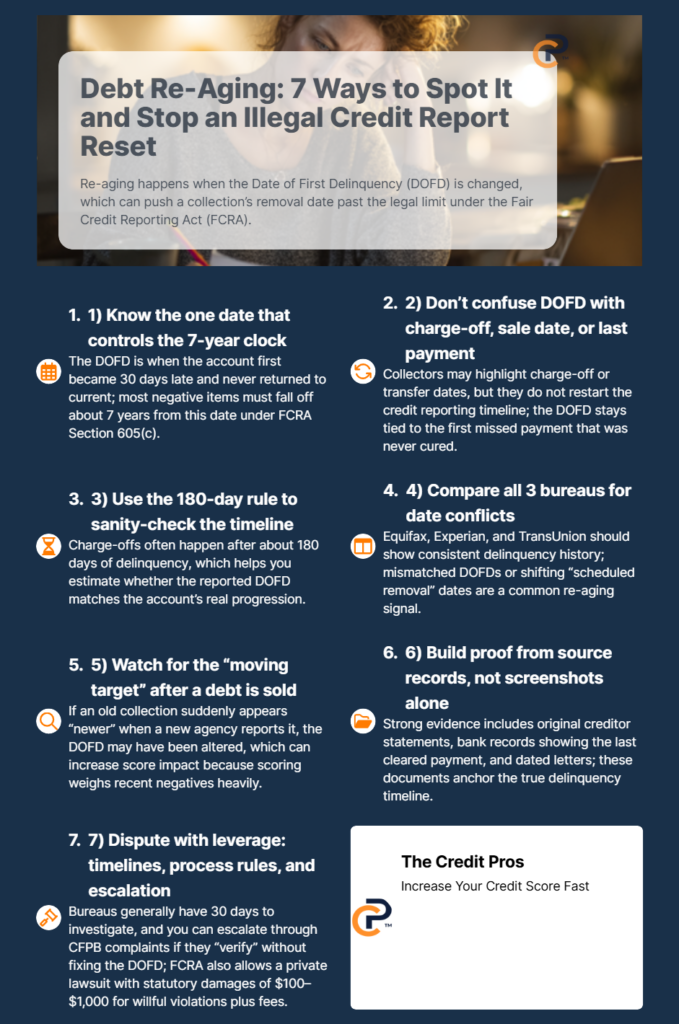
The Date of First Delinquency represents the moment your account became 30 days past due and never returned to current status. This date functions as the legal anchor point from which all credit reporting timelines flow. Under the Fair Credit Reporting Act, specifically Section 605(c), credit bureaus can report most negative information for seven years from this precise date, creating a fixed endpoint that collection agencies cannot legally extend regardless of how many times your debt changes hands. Understanding this rule is the foundation of spotting re-aging debt.

The 180-day rule establishes the technical framework for determining the DOFD. When you miss a payment and fail to bring your account current within 180 days, the original creditor typically charges off the debt and reports it as delinquent. The DOFD becomes locked in as the date you first missed that payment—not the charge-off date, not the date the debt was sold to a collector, and not the date you last made a partial payment. This distinction matters because collectors frequently confuse consumers by highlighting these other dates, which have no bearing on the seven-year reporting clock and often make re-aging debt harder to detect. Knowing this difference helps you challenge re-aging debt with the right documentation.
Credit bureaus calculate the mandatory removal date by adding seven years to the DOFD, creating what’s known as the “compliance date” in industry terminology. This calculation operates automatically within credit reporting systems, meaning that once the DOFD is established in a tradeline’s data, the system should prevent the account from appearing on your credit report beyond that seven-year mark. The problem emerges when collection agencies submit updated information with altered dates, overriding the original DOFD and effectively resetting the clock without legal authority to do so—this is a classic sign of re-aging debt. When this happens, re-aging debt can keep negative accounts on your report far longer than federal law allows.
Consumers often believe that making a payment on an old debt or acknowledging the debt verbally can restart the seven-year timeline. This misconception stems from confusion between credit reporting rules and the statute of limitations for debt collection lawsuits, which operate under different legal frameworks. For credit reporting purposes, the DOFD remains frozen at that original delinquency date regardless of subsequent payment activity, account sales, or collection attempts. Only the original creditor’s records of when the account first went delinquent determine this date, and no subsequent party in the collection chain has authority to modify it. Misunderstanding this rule can make people accept re-aging debt without realizing it. In reality, payment activity does not justify re-aging debt on your credit report.
The cascade effect of an incorrect DOFD extends far beyond simple timeline manipulation. When a debt appears newer than it actually is, credit scoring algorithms weight it more heavily in their calculations, treating it as fresh negative information rather than aging history. This artificial inflation of damage means your credit score suffers more severe penalties than warranted, potentially costing you thousands of dollars in higher interest rates or denied credit applications. The psychological burden compounds as well—consumers who thought they were approaching the end of their seven-year reporting period suddenly face the prospect of several additional years of credit damage caused by re-aging debt.
FCRA Section 605 provides explicit protection against obsolete information, stating that consumer reporting agencies cannot report accounts placed for collection or charged off “which antedate the report by more than seven years.” The statute uses the term “antedate,” which courts have interpreted to mean the date of original delinquency, not subsequent collection activity. This legal language gives you concrete grounds to challenge any re-aging debt, as the law doesn’t grant collection agencies discretion to reinterpret when delinquency occurred. The Metro 2 format, which standardizes how creditors and collectors report information to bureaus, includes a specific field for DOFD precisely to prevent the kind of manipulation that re-aging debt represents.
Identifying Re-Aging Through Forensic Credit Report Analysis
Your credit reports from Equifax, Experian, and TransUnion should tell the same story about any given debt, with identical dates for key milestones. The first step in identifying re-aging debt involves obtaining all three reports simultaneously and creating a comparison spreadsheet that lists each debt across the top and critical date fields down the side. You’re looking for the DOFD, the account opened date, the date of first delinquency, the charge-off date if applicable, and the date of last activity. When these dates differ across bureaus for the same original account, you’ve identified a red flag that demands investigation and may help you prove re-aging debt.
The “moving target” phenomenon represents one of the most obvious signs of re-aging debt. Pull your credit reports every few months and track whether dates associated with old debts shift forward in time. A legitimate debt maintains consistent historical dates regardless of how many times you check your report. If you notice that a collection account that previously showed a 2020 DOFD suddenly displays a 2022 date after being sold to a new collection agency, you’re witnessing re-aging debt in action. This manipulation often occurs during the transfer of debt portfolios, when new collectors submit their own reporting data without verifying the original delinquency timeline.
Your personal financial records provide the ground truth against which credit report information must be measured. Gather bank statements from the period when you first fell behind on the account in question, looking for the last successful payment that cleared your account. Credit card statements from the original creditor will show the progression of missed payments, late fees, and the eventual charge-off notation. These documents establish an independent timeline that exists outside the credit reporting system, giving you objective evidence of when delinquency actually occurred. Payment confirmations, whether digital receipts or canceled checks, carry timestamps that collection agencies cannot dispute when you’re documenting re-aging debt.
Collection letters themselves often contain the evidence needed to prove re-aging debt. The Fair Debt Collection Practices Act requires collectors to send an initial communication within five days of first contacting you, and this letter must include specific information about the debt. Compare the dates mentioned in these letters—when the debt was incurred, when it was charged off, when the current collector acquired it—against what appears on your credit reports. Discrepancies between the collector’s own written statements and their credit reporting reveal either incompetence or intentional manipulation, both of which strengthen your dispute position and make it easier to challenge re-aging debt.
Digital footprints create timestamped evidence that’s difficult to refute. If you communicated with the original creditor via email about payment difficulties, those messages contain metadata showing exact dates. Screenshots from online payment portals that display your account history, even if the account is now closed, preserve the original timeline. Account closure notifications, whether received by mail or email, document when the original creditor ceased doing business with you. These digital artifacts often survive longer than paper records and provide concrete proof of the authentic sequence of events leading to delinquency, which is especially useful when documenting re-aging debt.
The forensic approach to identifying re-aging debt requires patience and systematic record-keeping. Create a dedicated folder—physical or digital—where you compile every piece of documentation related to the debt in question. Organize materials chronologically, making it easy to identify gaps or inconsistencies in the timeline. This methodical documentation serves dual purposes: it helps you spot manipulation patterns you might otherwise miss, and it builds the evidence package you’ll need when disputing re-aging debt with credit bureaus and furnishers.
Creating a Comprehensive Documentation Package for Credit Bureau Disputes
Evidence quality determines dispute outcomes more than any other factor in the credit reporting dispute process, especially in a re-aging debt dispute. Original creditor statements showing your payment history carry the highest evidentiary weight because they come from the source that established the account relationship. These statements display the progression from current status to delinquency, showing exactly when payments stopped and the account deteriorated. Written charge-off notices from the original creditor explicitly state when they removed the debt from their active accounts, providing a documented endpoint that corresponds with the establishment of the DOFD and helps prove re-aging debt.
Dated correspondence creates a documentary chain that establishes timeline authenticity in a re-aging debt case. Letters from the original creditor discussing your account status, payment arrangements, or hardship programs all contain dates that anchor the true delinquency period. If you participated in any settlement negotiations or payment plans, the paperwork from those arrangements shows when the debt existed in its original form. Even collection letters from the first agency that acquired the debt after charge-off help establish the correct timeline, as their initial communication date must logically follow the original delinquency period.
Your dispute letter must transcend generic template language and address the specific FCRA violations at issue in a re-aging debt claim. Reference Section 623(a)(2) of the FCRA, which requires furnishers to correct and update information after receiving notice of inaccuracies. Cite the Metro 2 reporting format’s explicit requirement for accurate DOFD reporting in the compliance date calculation field. Demand correction of the erroneous dates rather than merely asking the bureau to “verify” information—verification often means the collector simply confirms what they previously reported without examining underlying documentation, which can allow re-aging debt to continue unchecked. Your letter should state clearly that the reported DOFD violates FCRA’s prohibition on reporting obsolete information under Section 605.
The comparative analysis attachment transforms your dispute from a consumer complaint into a documented case of reporting violations tied to re-aging debt. Create a table with columns for each credit bureau and rows for critical dates: DOFD, account opened, charge-off date, date of last payment, and scheduled removal date. Fill in what each bureau currently reports, then add a column showing what your documentation proves as the accurate dates. Include a final column calculating the correct removal date based on the true DOFD. This visual representation makes the discrepancies undeniable and demonstrates that you’ve conducted thorough research rather than making baseless claims.
Furnisher responsibilities under FCRA Section 623(a)(8) provide an additional avenue for dispute that many consumers overlook when dealing with re-aging debt. Send a qualified written request directly to the collection agency reporting the re-aged debt, separate from your credit bureau disputes. This letter must identify the specific information you dispute and explain why it’s inaccurate, including your supporting documentation for re-aging debt. The furnisher must conduct a reasonable investigation and report the results back to you, and if they cannot verify the accuracy of the DOFD they’re reporting, they must correct it with all three bureaus. This dual-track approach—disputing with bureaus and furnishers simultaneously—creates multiple pressure points for correction.
Documentation of your dispute process itself becomes critical evidence if you need to escalate a re-aging debt complaint to regulatory complaints or legal action. Send all dispute letters via certified mail with return receipt requested, preserving proof of when the bureau or furnisher received your dispute. Keep copies of everything you send, along with the tracking numbers and delivery confirmations. When responses arrive, document the date received and scan or photograph every page. This paper trail demonstrates that you followed proper procedures, gave the bureau and furnisher adequate opportunity to correct the violation, and can prove they failed to fulfill their legal obligations if they don’t resolve the re-aging debt issue.
Challenging Inadequate Bureau Responses and Escalating Your Dispute
Credit bureaus respond to millions of disputes annually, and the volume creates systemic pressure to process claims quickly rather than thoroughly. When you receive a response stating that disputed information has been “verified as accurate,” you need to understand what verification actually means in practice. The e-OSCAR system, which facilitates communication between credit bureaus and furnishers, transmits disputes using standardized codes that reduce your detailed explanation to a two-digit category. The furnisher receives this code, checks a box confirming the information matches their records, and returns the response—often without examining the underlying documentation you provided. This shortcut is one reason re-aging debt disputes often get denied on the first attempt.
This cursory review process explains why initial disputes frequently fail even when you’ve submitted compelling evidence. The collection agency receiving the e-OSCAR inquiry may simply confirm that their database shows the DOFD they previously reported, without investigating whether that date is actually correct or whether it conflicts with the original creditor’s records. They’re verifying internal consistency rather than objective accuracy, a distinction that makes all the difference when re-aging debt has occurred. The bureau accepts this confirmation at face value and closes your dispute, leaving the erroneous information in place.
Your re-dispute strategy must explicitly challenge the verification methodology itself. Submit a second dispute that doesn’t simply repeat your original claims but instead questions how the verification was conducted. Request copies of the specific documents the bureau relied upon to verify the DOFD, citing your right under FCRA to know the results of their investigation. Point out that the furnisher’s attestation doesn’t constitute reasonable investigation when you’ve provided contradictory evidence from the original creditor. Explain that accepting the collector’s word without examining source documents violates the bureau’s obligation to conduct a genuine investigation, especially in a re-aging debt case.
The Consumer Financial Protection Bureau serves as your primary regulatory escalation path when credit bureaus fail to correct obvious errors. File a complaint through the CFPB’s online portal, attaching your evidence package and documenting the bureau’s inadequate response to your disputes. The CFPB forwards complaints to the relevant company and requires a response, creating accountability that internal dispute processes often lack. State attorneys general consumer protection divisions offer another escalation avenue, particularly effective when you can demonstrate a pattern of similar violations affecting multiple consumers. The Federal Trade Commission accepts complaints about FCRA violations, and while they typically don’t intervene in individual cases, your complaint contributes to enforcement data that may trigger broader investigations.
Procedural violations carry weight independent of the underlying dispute about dates. FCRA requires credit bureaus to complete investigations within 30 days of receiving your dispute unless they determine it’s frivolous. If a bureau exceeds this timeframe, they’ve violated the statute regardless of whether your substantive claim about re-aging is correct. Similarly, if they fail to forward your documentation to the furnisher, conduct no meaningful investigation beyond accepting the furnisher’s automated response, or don’t provide you with results of their investigation, these procedural failures strengthen your position. Document every instance where the bureau or furnisher failed to meet their statutory obligations, as these violations may support regulatory complaints or legal claims.
Professional credit repair support offers strategic advantages when disputes become complex or meet persistent resistance. Experienced credit repair professionals understand bureau response patterns, recognizing which dispute angles generate action versus which trigger automatic denials. They maintain relationships with bureau personnel that can facilitate resolution, though these relationships don’t replace the need for solid evidence. Credit repair companies can pursue multiple dispute angles simultaneously—challenging the DOFD directly, questioning the verification process, filing regulatory complaints, and preparing for potential legal action—while you focus on your financial goals rather than becoming consumed by the dispute process. Their expertise in FCRA procedures and documentation requirements often accelerates resolution compared to consumer self-help efforts, particularly when dealing with sophisticated violations like re-aging that require technical knowledge of credit reporting standards.
Enforcing Your FCRA Rights Through Legal Action and Settlement
The Fair Credit Reporting Act grants you a private right of action, meaning you can file a lawsuit against credit bureaus and furnishers who violate its provisions without needing government intervention. This legal authority transforms FCRA from abstract consumer protection into enforceable rights with real consequences for violators. When a collection agency re-ages your debt and a credit bureau continues reporting it despite your documented evidence of the correct DOFD, they’ve potentially committed willful or negligent violations that expose them to liability. Willful violations—those where the company knew or should have known their conduct violated FCRA—can result in statutory damages ranging from $100 to $1,000 per violation, plus your actual damages and attorney fees.
The distinction between willful and negligent violations matters for damages calculations but not for your ability to pursue legal action. Negligent violations occur when a company fails to comply with FCRA despite intending to follow the law, perhaps due to inadequate procedures or training. These violations entitle you to actual damages—the quantifiable harm you suffered, such as higher interest rates, denied credit, or lost employment opportunities due to the credit reporting error. Courts have recognized emotional distress damages in FCRA cases as well, acknowledging that credit reporting errors cause genuine psychological harm beyond financial impact. Attorney fees provisions mean that lawyers can take FCRA cases on contingency, removing financial barriers to enforcement.
Statute of limitations considerations add urgency to addressing re-aging violations. You have two years from when you discover an FCRA violation to file a lawsuit, or five years from when the violation occurred, whichever comes first. This timeline means you can’t wait indefinitely to take action once you’ve identified re-aging. Beyond credit reporting implications, re-aging may also illegally restart your state’s statute of limitations for debt collection lawsuits. Each state sets its own timeframe—typically three to six years—during which a creditor can sue you to collect a debt. If a collector manipulates dates to make a debt appear newer, they might claim the statute of limitations hasn’t expired when it actually has, exposing themselves to Fair Debt Collection Practices Act violations in addition to FCRA violations.
Documentation serves as your insurance policy throughout this process, preserving evidence that may become trial exhibits if resolution requires legal intervention. Every dispute letter, bureau response, collection notice, and piece of supporting evidence you’ve gathered demonstrates your case chronology and the defendants’ knowledge of the violation. Courts give significant weight to written communications showing that you notified the bureau and furnisher of the error, provided supporting documentation, and they failed to correct it. Your paper trail proves not just that re-aging occurred, but that the responsible parties knew about it and chose not to fix it, strengthening claims of willful violation.
Documented FCRA violations give you negotiating leverage to demand more than simple date corrections. When a collection agency faces potential liability for re-aging, they may agree to delete the entire tradeline from your credit reports in exchange for releasing legal claims. This outcome exceeds what you could achieve through standard dispute processes, which typically result only in corrected dates while the negative information remains. Settlement negotiations often occur after you’ve filed regulatory complaints or consulted with an FCRA attorney, demonstrating your willingness to pursue enforcement. The threat of litigation, backed by solid evidence, frequently produces results that seemed impossible during earlier dispute rounds.
Preventing future re-aging requires ongoing vigilance even after successful disputes. Monitor your credit reports regularly—at minimum quarterly—to ensure corrected information stays corrected and new re-aging debt attempts don’t emerge. Credit monitoring services alert you to changes, but they can’t prevent unauthorized reporting.
Taking Control of Your Credit Timeline
Re-aging doesn’t just extend how long a debt appears on your credit report—it fundamentally distorts the legal protections you’re entitled to under the Fair Credit Reporting Act. The Date of First Delinquency represents more than a bureaucratic detail; it’s the anchor point that determines when you’ll finally be free from the credit damage of past financial struggles. When collection agencies manipulate this date, they’re not making innocent mistakes—they’re violating federal law in ways that cost you money, opportunities, and peace of mind. The evidence you need to fight back already exists in your bank statements, creditor letters, and credit reports; you simply need to know where to look and how to present it in a way that credit bureaus can’t dismiss with automated responses.

Understanding re-aging transforms you from a passive victim of credit reporting errors into someone who can actively enforce your rights. The seven-year timeline isn’t negotiable, regardless of how many times your debt changes hands or how aggressively collectors pursue payment. Armed with documentation proving the true delinquency date and knowledge of FCRA’s specific provisions, you possess the tools to correct these violations through disputes, regulatory complaints, or legal action when necessary. The question that opened this discussion—whether you know how to build a case credit bureaus can’t ignore—now has a clear answer: you document the truth, demand correction through proper channels, and escalate systematically when initial disputes fail. Your credit timeline belongs to you, not to collection agencies looking to maximize their reporting window, and every day you allow re-aging to stand unchallenged is another day you’re accepting credit damage you don’t legally owe.