

When the economy stumbles, most people focus on obvious impacts like job losses and market volatility. But there’s a hidden consequence that affects millions of Americans in ways they don’t even realize: economic downturns create a perfect storm for credit report errors to multiply and spread. During financial stress, overwhelmed institutions make more reporting mistakes, consumers monitor their credit less frequently, and the line between legitimate hardship and reporting inaccuracies becomes dangerously blurred—intensifying the economic downturn credit impact many people never see coming.
What makes this particularly troubling is how these errors don’t affect everyone equally. If you already have credit report inaccuracies, an economic downturn can push your score off a cliff while others with clean reports experience manageable declines. National credit statistics might show recovery, but they often mask the reality that certain groups remain trapped by a combination of economic hardship and persistent reporting errors. Understanding the economic downturn credit impact becomes essential, because the systems meant to track creditworthiness become least reliable during the times when consumers need accuracy the most.
The Hidden Mechanics: How Economic Stress Amplifies Credit Report Errors
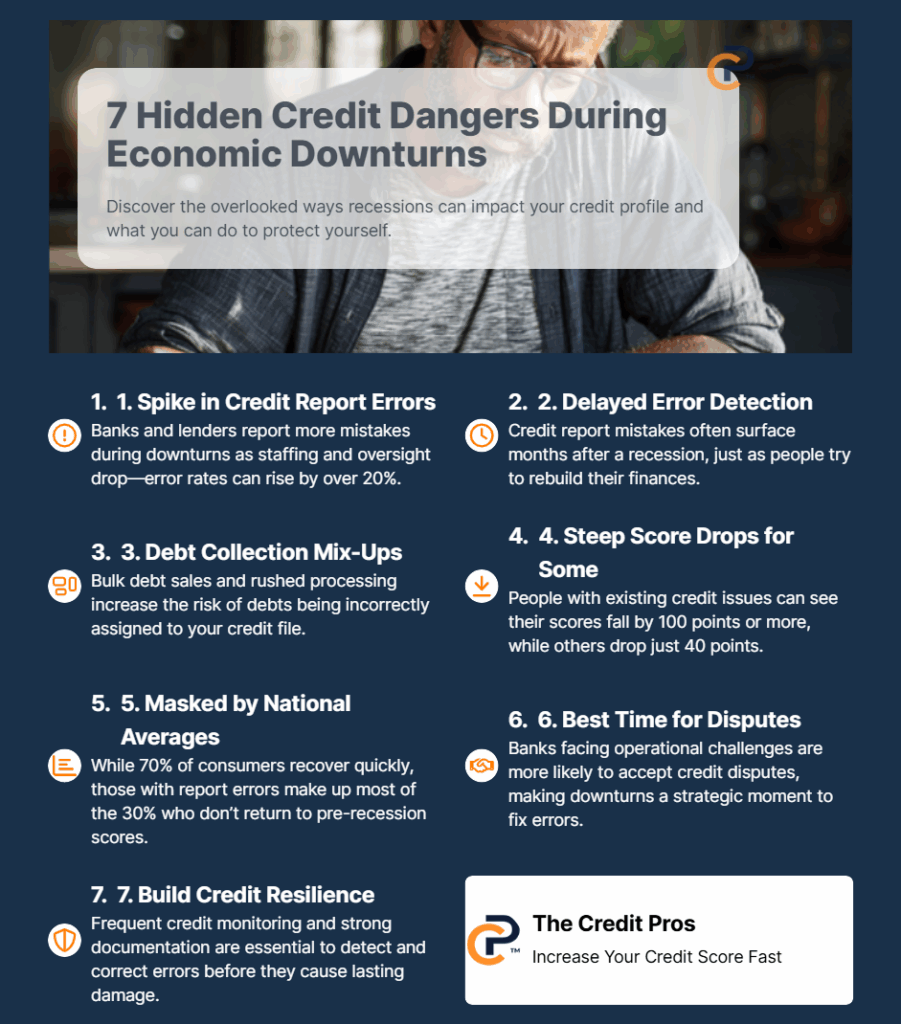
Economic downturns create a cascade of operational challenges within financial institutions that directly translate to increased credit reporting inaccuracies. During periods of financial stress, banks and credit card companies often implement cost-cutting measures that reduce staffing in their data management departments, leading to a measurable uptick in reporting mistakes. These institutions simultaneously face higher volumes of account modifications, payment deferrals, and account closures, all of which amplify the economic downturn credit impact on consumers who rely on accurate reporting during periods of financial instability.

The timing of when these errors surface presents a particularly complex challenge for consumers. Credit report errors generated during economic stress often don’t appear immediately, instead manifesting months later when individuals are attempting to rebuild their financial standing. This delayed visibility worsens the economic downturn credit impact, as many reporting processes use batch updates and verification procedures that take 60 to 90 days to finalize. Consumers already struggling due to recession-related hardships may not uncover new inaccuracies until they urgently need credit for recovery.
Debt collection acceleration during economic downturns significantly increases the likelihood of misattributed accounts appearing on credit reports. Collection agencies often purchase debt portfolios in bulk during recessions, processing them rapidly and sometimes carelessly. The speed-driven environment heightens the economic downturn credit impact, causing accounts to be assigned to the wrong individuals and compounding the financial challenges faced by already vulnerable consumers.
The paradox emerges that consumers need access to credit most during economic downturns—precisely when existing report inaccuracies become the most damaging. This timing creates a vulnerability window where individuals with pre-existing credit report errors face exponentially greater obstacles securing emergency funding, refinancing options, or employment opportunities requiring credit checks. As the economic downturn credit impact intensifies, consumers must navigate a system least reliable when they need it most.
The Disproportionate Impact: Why Pre-Existing Credit Issues Create Deeper Financial Downturns
Individuals entering economic downturns with existing credit report errors experience dramatically steeper score declines compared to those with accurate credit profiles. Credit scoring algorithms apply mathematical penalties that compound when multiple negative factors appear simultaneously, creating a “credit cliff” effect where small additional negatives result in disproportionately large score drops. This dynamic intensifies the economic downturn credit impact, as someone with a 650 score due to existing errors might see a 100-point drop, while a consumer with a clean 720 score may experience far less disruption from the same recession-related pressures.
The compounding effect occurs when legitimate economic hardship layers onto pre-existing credit report inaccuracies, creating a situation where consumers face penalties for both actual financial challenges and reporting errors simultaneously. During recession periods, credit utilization often spikes as people rely more heavily on available credit, but this surge becomes especially harmful for those already burdened with inaccuracies. This dual pressure amplifies the economic downturn credit impact, as the scoring system interprets both genuine hardship and erroneous data as elevated financial risk.
Credit scoring models demonstrate timing sensitivity that particularly disadvantages individuals with existing credit report errors during economic recovery phases. When legitimate economic hardship begins to resolve, consumers with clean credit histories typically see relatively fast score rebounds as positive payment patterns resume. In contrast, individuals with underlying inaccuracies experience delayed improvement because the errors continue to suppress their scores long after their financial situation stabilizes—further worsening the economic downturn credit impact during the recovery period.
The mathematical structure of credit scoring algorithms creates additional challenges for error-affected consumers during economic stress. These systems place greater weight on recent negative information, meaning recession-related impacts carry amplified penalties when they occur alongside existing inaccuracies. This scoring bias effectively punishes individuals twice—once for the wrongful data and again for the financial hardship—heightening the economic downturn credit impact precisely when vulnerable consumers need accurate reporting the most.
National Recovery Trends vs Individual Credit Realities: The Statistical Masking Effect
National credit averages during economic recovery periods often paint a misleadingly optimistic picture that obscures the persistent struggles of individuals affected by credit report errors. When economists and policymakers analyze aggregate credit data, they typically observe gradual improvement in average scores as employment returns and consumer spending normalizes. However, this broad statistical improvement often hides the true economic downturn credit impact on individuals whose recovery is hindered by longstanding inaccuracies in their credit files.
The phenomenon of “statistical invisibility” occurs when credit report error victims fail to benefit from broader economic recovery trends, causing their continued struggles to disappear within averaged national data. While national credit statistics might indicate that 70% of consumers have returned to pre-recession score levels, this figure can obscure the deeper economic downturn credit impact experienced by the remaining 30%, many of whom are disproportionately burdened by pre-existing reporting errors.
Credit score distribution patterns shift significantly during and after economic downturns, creating new segments of disadvantaged consumers who become concentrated in lower score ranges. These shifts reveal that recovery does not lift all consumers equally. Those with underlying inaccuracies often remain stuck in subprime categories, demonstrating a lingering economic downturn credit impact that persists long after average scores show improvement.
The recovery timeline disparity becomes particularly evident when comparing individual credit trajectories to national trends. While aggregate data might show score recovery within 18–24 months, consumers with existing errors often require 36–48 months or longer to achieve similar progress. This extended timeline highlights how the economic downturn credit impact lingers, as these individuals must repair both recession-related damage and persistent credit reporting errors simultaneously.
The role of credit mix changes during economic downturns further complicates individual recovery patterns within broader positive trends. Many consumers diversify their credit portfolios during recovery—adding new account types or consolidating debt—but these improvements may not translate into score gains for individuals whose profiles remain suppressed by ongoing inaccuracies. For these consumers, the economic downturn credit impact continues to stall progress long after national metrics suggest overall financial health has improved.
Strategic Credit Repair Framework: Leveraging Economic Cycles for Maximum Impact
Economic downturns create unique opportunities for effective credit repair strategies that aren’t available during stable economic periods. Financial institutions undergoing operational stress often become more receptive to credit disputes and corrections, particularly when these institutions are simultaneously restructuring their own internal processes. This creates a strategic moment where the economic downturn credit impact works in consumers’ favor, opening a “dispute window advantage” in which overwhelmed creditors may remove disputed items rather than allocate resources to defend questionable entries.
The optimal timing for credit repair activities follows a counterintuitive pattern that contradicts traditional advice about waiting for economic stability. Rather than postponing efforts until conditions improve, strategic consumers can leverage institutional disruption to secure stronger dispute outcomes. Creditor responsiveness often peaks when organizations are undergoing system upgrades, updating reporting frameworks, or consolidating operations—all conditions driven by the broader economic downturn credit impact, which shifts internal priorities toward efficiency.
Advanced techniques for distinguishing between recession-related credit damage and pre-existing errors become essential during periods of economic stress. Consumers must systematically evaluate which negative items reflect legitimate hardship and which represent longstanding inaccuracies. This distinction is critical because the economic downturn credit impact can amplify both categories, making it even more important to prioritize disputes that address errors rather than temporary financial setbacks.
Strategic sequencing of credit repair activities during economic recovery phases can maximize impact by aligning dispute efforts with creditor operational cycles. The most effective approach involves:
- Initiating disputes for clear inaccuracies during peak creditor disruption periods
- Timing legitimate hardship negotiations during early recovery phases when creditors seek to retain customers
- Scheduling follow-up disputes to coincide with creditor system update periods
- Coordinating multiple dispute rounds to maintain continuous pressure on inaccurate reporting
The counterintuitive benefits of addressing credit report errors during economic stress rather than waiting for stability stem from the reduced scrutiny that disputes receive when creditors are managing higher-priority operational challenges. Financial institutions dealing with increased delinquencies, system updates, and regulatory compliance often allocate fewer resources to defending disputed credit report entries, creating windows of opportunity for successful error removal.
Building Credit Resilience: Future-Proofing Your Profile Against Economic Volatility
Proactive credit monitoring strategies must account for the increased error rates that historically accompany economic uncertainty periods. Traditional monthly monitoring becomes insufficient during economic downturns, requiring consumers to implement more frequent review cycles that can detect inaccuracies before they become entrenched in credit profiles. This enhanced approach acknowledges that the economic downturn credit impact includes a spike in reporting mistakes that must be addressed immediately to prevent long-term damage.
Creating robust credit documentation systems becomes essential for withstanding the operational disruptions that economic downturns bring to financial institutions. Consumers who maintain comprehensive records of their credit interactions, payment histories, and account modifications position themselves to quickly identify and dispute inaccuracies when they appear. These documentation systems become even more valuable as the economic downturn credit impact triggers mergers, acquisitions, staffing shortages, or system migrations—common conditions that increase the risk of reporting errors.
The concept of “credit resilience scoring” extends beyond traditional credit scores to measure a consumer’s ability to maintain credit profile accuracy during economic volatility. This framework evaluates monitoring frequency, dispute readiness, record completeness, and the diversity of verifiable credit relationships. Strengthening these resilience factors helps consumers withstand the economic downturn credit impact, ensuring their credit profiles remain stable even when financial institutions experience operational strain.
Establishing credit repair protocols before economic stress occurs provides crucial advantages when rapid response becomes necessary. These protocols should include pre-identified dispute strategies, documented relationships with creditors, and systematic approaches for escalating credit report corrections. The preparation allows consumers to implement immediate responses when economic conditions create environments conducive to credit reporting errors.
Advanced early warning indicators can signal when economic conditions may trigger increased credit reporting errors, enabling proactive protective measures. These indicators include financial institution merger announcements, regulatory changes affecting credit reporting procedures, and economic stress signals that historically correlate with increased credit report inaccuracies. Monitoring these indicators allows consumers to intensify their credit monitoring and documentation efforts before problems manifest in their credit profiles.
Conclusion: Taking Control When Systems Fail You
Economic downturns don’t just damage credit scores—they fundamentally alter how credit reporting systems function, creating a hidden crisis that disproportionately affects those who can least afford additional financial setbacks. The evidence reveals that national recovery statistics mask a troubling reality: individuals with pre-existing credit report errors face exponentially longer recovery periods and steeper score declines, while operational stress within financial institutions generates new inaccuracies precisely when consumers need reliable credit access most.

The convergence of economic hardship and credit reporting failures creates a perfect storm that traditional financial advice simply doesn’t address. While economists celebrate aggregate recovery trends, millions of Americans remain trapped by the intersection of legitimate financial challenges and persistent credit report errors that compound their difficulties. Understanding these hidden dynamics isn’t just about protecting your credit score—it’s about recognizing that when the systems designed to measure creditworthiness become unreliable, your financial future depends on your ability to identify and correct these failures before they define your economic reality.