

Your credit report contains dozens of dates—account opened, last payment, charge-off date, date reported. But there’s one date that matters more than all the others combined, and most people have no idea it even exists. The Date of First Delinquency determines exactly when negative items must disappear from your credit report, yet it’s frequently wrong, buried in confusing terminology, or deliberately manipulated to keep damaging information visible for years longer than the law allows.
Here’s what makes this particularly frustrating: you might assume that a charge-off from 2019 will drop off your report in 2026, but if the Date of First Delinquency is incorrect—showing 2020 instead of the actual 2018 first missed payment—you’re stuck with that negative mark for two extra years. Credit bureaus and collection agencies don’t always get this date right, and when accounts change hands or get disputed and reinstated, the Date of First Delinquency can shift without you noticing. Understanding how to find, verify, and challenge this single date could be the difference between another year of credit damage and finally moving forward with a clean slate.
What is DOFD? The Date That Sets Your Credit Report’s Clock
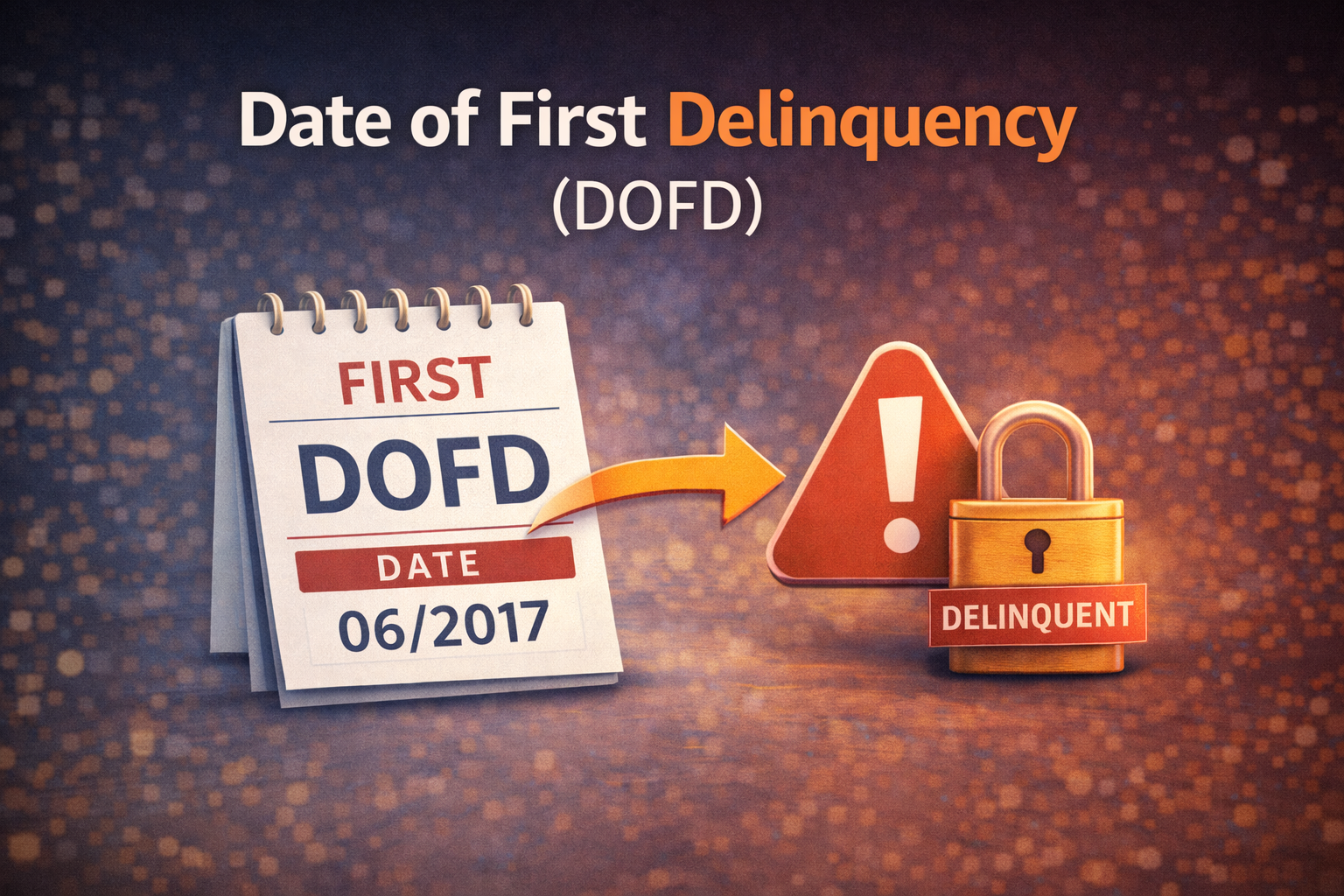
The Date of First Delinquency represents the precise moment you first missed a payment that you never made up. This date carries legal weight under the Fair Credit Reporting Act, establishing an immovable starting point for how long negative information can remain on your credit report. Once you miss a payment and fail to bring the account current before the next billing cycle, that missed payment date becomes your Date of First Delinquency—a permanent marker that no subsequent action can alter.

The immovability of Date of First Delinquency stems from the “original delinquency” concept embedded in federal credit reporting law. When you fall behind on payments, creditors report the delinquency to credit bureaus, and the first date of that continuous delinquency becomes fixed. Even if you later make partial payments, enter a payment arrangement, or acknowledge the debt, the Date of First Delinquency cannot legally change. This protection prevents creditors and collection agencies from artificially extending how long negative information damages your credit by resetting the clock each time the account changes hands or you interact with it.
Understanding what Date of First Delinquency is not proves equally critical to protecting your credit timeline. The “Date Opened” reflects when you first established the account, which could be years before any payment problems occurred. “Date Reported” indicates when a creditor or collector most recently updated the account information with credit bureaus, which changes monthly and has no bearing on when the item must be removed. “Date of Last Activity” captures the most recent transaction or payment on the account, while “Last Payment Date” shows specifically when you last submitted payment. Confusing any of these dates with DOFD can lead you to miscalculate when negative items should disappear—a costly error that extends credit damage unnecessarily.
The distinction becomes particularly important when examining accounts that experienced multiple delinquency periods. If you fell behind, then caught up and brought the account current, that initial missed payment does not become your v because you corrected the delinquency. However, if you subsequently fell behind again and never recovered, the DOFD becomes the first missed payment in that second, continuous delinquency period. The key factor is continuous delinquency without the account returning to current status. An account that rolled from 30 days late to 60 days late to 90 days late to charge-off without ever being brought current has its Date of First Delinquency set at that very first missed payment in the sequence.
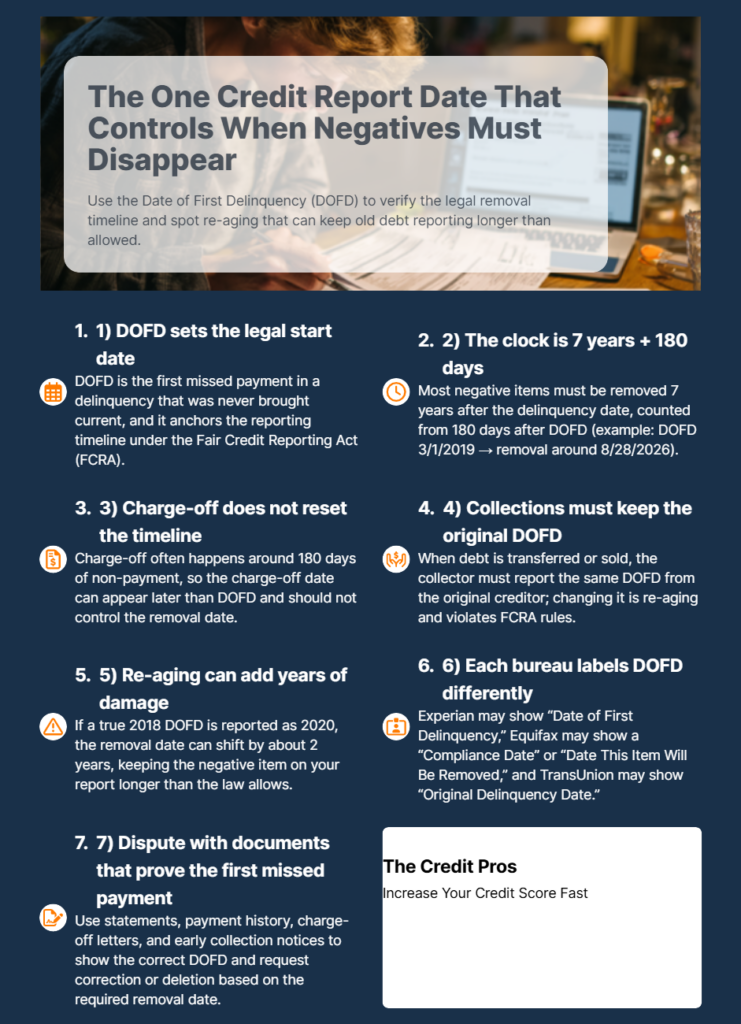
Credit bureaus complicate identification by using different terminology across their reporting systems. Experian often labels this date as “Date of First Delinquency” in their consumer reports, providing relatively clear identification. Equifax frequently uses the term “Date of First Delinquency” but may also reference a “Compliance Date” or “Date This Item Will Be Removed,” which should align with seven years from the Date of First Delinquency. TransUnion sometimes displays this information as “Original Delinquency Date” or within their estimated removal date calculations. These variations mean you cannot simply scan your credit report for identical language across all three bureaus—you need to understand each bureau’s specific formatting to locate the controlling date for each negative item.
How DOFD Determines When Negative Items Disappear From Your Credit Report
The seven-year reporting period for most negative credit information begins exactly 180 days from your Date of First Delinquency. This six-month buffer exists because federal law recognizes that accounts reaching 180 days of continuous delinquency have typically progressed to charge-off status or collection placement. The calculation means that if your Date of First Delinquency was March 1, 2019, the seven-year clock started on August 28, 2019, and the negative item must be removed by August 28, 2026. This timeline applies regardless of whether the account was charged off, sold to collectors, or remains unpaid.
Charge-offs create particular confusion because consumers often assume the charge-off date starts the seven-year clock. When a creditor charges off an account—typically after 180 days of non-payment—they’re making an internal accounting decision to write off the debt as a loss. The charge-off date appears prominently on credit reports and carries significant weight in credit scoring models, but it does not reset or establish the Date of First Delinquency. Your Date of First Delinquency remains anchored to that first missed payment that led to the continuous delinquency, which occurred months before the charge-off. A March 2019 Date of First Delinquency with a September 2019 charge-off date means the seven-year countdown began in August 2019, not September 2019, and certainly not when the account was charged off.
Collection accounts present the most frequent source of Date of First Delinquency disputes and illegal re-aging. When your original creditor sells or transfers your debt to a collection agency, that collector must report the same DOFD that the original creditor established. The debt changes hands, but the Date of First Delinquency does not change with it. This principle holds true whether the debt is sold once or passes through five different collection agencies over the years. Each subsequent collector inherits the original Date of First Delinquency and must report it accurately. The collection account reporting timeline remains tied to the original creditor’s delinquency date, ensuring that selling debt cannot extend the seven-year reporting period beyond what federal law allows.
Debt buyers frequently violate this requirement by reporting a new DOFD that corresponds with when they purchased the account. A debt buyer that acquires your account in 2024 might report a 2024 Date of First Delinquency, effectively granting themselves seven additional years to damage your credit beyond what the original 2019 delinquency would allow. This practice constitutes illegal re-aging and violates the Fair Credit Reporting Act’s provisions protecting consumers from indefinite credit damage. Collection agencies benefit from this manipulation because it makes old debts appear recent, potentially increasing their collection success rates and extending their ability to leverage credit report damage as pressure for payment.
Several edge cases complicate Date of First Delinquency identification and require careful analysis. Bankruptcy accounts follow different rules, with Chapter 7 bankruptcies remaining on credit reports for ten years from the filing date and Chapter 13 bankruptcies for seven years from the filing date—these timelines do not depend on Date of First Delinquency. Settled debts and paid collections maintain the original Date of First Delinquency despite resolution, meaning payment does not trigger removal or reset the timeline. Accounts with partial payment histories where you made sporadic payments after initial delinquency require examining when continuous delinquency began, not when individual late payments occurred. If you missed March 2019, paid in April 2019, then missed May 2019 and never paid again, your Date of First Delinquency is May 2019 because that’s when the continuous delinquency that led to charge-off or collection began.
Where to Find Your DOFD on Credit Reports From Each Bureau
Locating your DOFD requires navigating credit report formats that vary significantly across the three major bureaus. Experian typically displays Date of First Delinquency in the account details section of each tradeline, often labeled explicitly as “Date of First Delinquency” beneath other account dates. You’ll find this information by examining the detailed view of any negative account, where multiple dates appear in chronological order. Experian also provides an “Estimated month and year this item will be removed” field, which should reflect seven years and 180 days from the Date of First Delinquency—if this removal date seems too far in the future, your Date of First Delinquency may be incorrect.
Equifax structures their credit reports with a “Compliance Date” field that represents when the account should be removed from your report based on the DOFD. This compliance date appears in the account status section and should calculate to seven years from the DOFD plus the 180-day buffer. Equifax reports also include “Date of Status” and “Date Reported,” which update regularly and should not be confused with Date of First Delinquency. The compliance date serves as your verification tool—if it extends beyond what you calculate based on when you first fell behind, you’ve identified a potential error worth investigating. Equifax’s format requires working backward from the compliance date to determine what Date of First Delinquency the bureau has on file.
TransUnion presents DOFD information within their account history section, sometimes labeled as “Original Delinquency Date” or embedded in the removal date calculation. TransUnion reports often display a timeline of account status changes, showing when the account progressed from current to 30 days late, 60 days late, and beyond. This timeline provides valuable context for verifying Date of First Delinquency accuracy because you can trace the progression of delinquency through documented status changes. The first date showing a delinquent status that continued without the account returning to current should align with the reported DOFD.
Cross-referencing multiple dates on a single tradeline reveals inconsistencies that signal Date of First Delinquency errors. Start by identifying all dates associated with the account: when opened, when first reported delinquent, when charged off, when sold to collections, and when most recently updated. Your payment history should show a clear progression from on-time payments to missed payments, establishing when continuous delinquency began. If the DOFD appears later than the first missed payment in your payment history, or if it coincides with a debt sale date rather than an actual delinquency date, you’ve found evidence of reporting errors. The account status timeline should tell a coherent story—any dates that contradict this narrative warrant scrutiny.
Bureau inconsistencies across Experian, Equifax, and TransUnion for the same account indicate serious reporting problems. Federal law requires furnishers to report accurate information consistently to all bureaus, meaning your DOFD should match across all three reports. When one bureau shows a March 2019 DOFD while another shows September 2019 for the identical account, at least one bureau has incorrect information. These discrepancies typically arise when collection agencies report to different bureaus at different times, when original creditors update some bureaus but not others, or when dispute resolutions create inconsistent corrections. Each variation potentially affects your credit score differently and may result in the negative item remaining visible longer on some reports than others.
Collection agencies frequently omit DOFD information entirely from their credit report submissions, leaving the field blank or using placeholder dates. This omission violates reporting requirements because consumers cannot verify when negative items should be removed without access to DOFD data. When collection accounts appear on your credit report without a clearly stated DOFD or compliance date, the collector has failed to provide complete information required under the Fair Credit Reporting Act. This missing information creates grounds for dispute because you cannot determine whether the account is being reported within the legal timeframe without the DOFD anchor point.
Documentation from original creditors provides the most reliable evidence for establishing your true DOFD. Account statements from the period when you first fell behind show exact payment due dates and when payments were missed. Charge-off letters from original creditors typically reference the delinquency timeline leading to the charge-off decision. Collection placement notices often state when the account first became delinquent with the original creditor. Payment histories obtained directly from original creditors through account access or formal requests create an indisputable record of when continuous delinquency began. These primary source documents override credit report dates when discrepancies arise because they represent contemporaneous records created at the time of delinquency rather than potentially flawed data transmitted through multiple reporting channels years later.
Common DOFD Manipulation Tactics That Extend Credit Damage
Re-aging schemes exploit consumer confusion about what actions reset the credit reporting timeline. Making a small payment on an old debt does not and cannot legally change your DOFD, yet some collectors report such payments as if they restart the seven-year clock. Entering a payment plan similarly has no legal effect on DOFD, though collectors may improperly update account dates to reflect when the payment arrangement began. Acknowledging a debt—whether verbally, in writing, or through partial payment—provides collectors with leverage for continued collection efforts but cannot legally alter the immovable DOFD established when you first fell behind. These tactics succeed because consumers believe that any interaction with a debt might reset their credit timeline, leading them to avoid legitimate dispute rights or accept extended credit damage as inevitable.
The debt sale shuffle creates systematic DOFD manipulation as accounts pass through multiple collection agencies and debt buyers. Each time a debt is sold, the new owner may report the account with a DOFD that reflects their purchase date rather than the original delinquency date from years earlier. A debt that first became delinquent in 2018 might show a 2020 DOFD when sold to a first debt buyer, then a 2022 DOFD when sold again to a second debt buyer, and a 2024 DOFD when a third debt buyer acquires it. This progression artificially extends the credit reporting period by years, keeping the negative item visible well beyond the seven-year window federal law intended. The practice violates FCRA requirements but occurs frequently because debt buyers operate with incomplete information from previous owners and face minimal enforcement consequences for reporting errors.
Reinstated accounts following dispute resolution present a particularly insidious form of DOFD manipulation. When you successfully dispute a negative item and the credit bureau removes it, the furnisher retains the right to re-investigate and potentially reinstate the account if they verify it as accurate. During this reinstatement process, some furnishers report the account with an altered DOFD—sometimes inadvertently due to system limitations, sometimes deliberately to extend the reporting period. You might dispute an account in February 2026 that should have been removed by March 2026 based on its original DOFD, see it deleted, then watch it reappear in April 2026 with a DOFD that extends the removal date to 2028. This manipulation effectively punishes consumers for exercising their dispute rights by extending credit damage beyond what the original delinquency timeline allowed.
Accounts with multiple delinquency periods require careful analysis to determine which missed payment establishes the controlling DOFD. When you fall behind, catch up completely, then fall behind again months or years later, the second period of continuous delinquency establishes a new DOFD. However, creditors sometimes report the first-ever missed payment as the DOFD even when you brought the account current before falling behind again. This error works against you when the actual continuous delinquency that led to charge-off or collection began later than the first-ever late payment. Conversely, some creditors report only the charge-off date as DOFD, ignoring earlier missed payments that should establish an earlier DOFD and thus an earlier removal date. The correct DOFD is always the first missed payment that led to continuous delinquency without the account returning to current status.
The statute of limitations versus credit reporting period confusion enables creditors to mislead consumers about their rights and timelines. The statute of limitations governs how long creditors can sue you to collect a debt, typically ranging from three to six years depending on state law and debt type. The credit reporting period governs how long negative information can appear on your credit report, which is seven years for most delinquencies regardless of state statute of limitations. Creditors sometimes conflate these timelines by suggesting that making a payment that restarts the statute of limitations also restarts the credit reporting period. This conflation is false—the statute of limitations and DOFD operate independently under different legal frameworks. A payment that restarts the statute of limitations in your state has absolutely no effect on your DOFD or when the negative item must be removed from your credit report.
Automated reporting errors introduce DOFD inaccuracies through system migrations, data formatting issues, and bureau processing mistakes that occur without human oversight. When creditors or collection agencies migrate account data to new computer systems, date fields may not transfer correctly, resulting in DOFDs that reflect system migration dates rather than actual delinquency dates. Data formatting inconsistencies between furnisher systems and credit bureau systems can cause dates to shift by days, months, or years during transmission. Credit bureaus processing millions of monthly updates may experience technical glitches that randomly alter dates without triggering quality control alerts. These automated errors lack intentional malice but cause real harm by extending credit reporting periods beyond legal limits. The systematic nature of these technical failures means individual consumers bear the burden of identifying and correcting errors that originate in complex data processing systems they cannot access or audit.
How to Dispute Incorrect DOFD and Reclaim Your Credit Timeline
Building your evidence file begins with gathering documents that establish your true DOFD through contemporaneous records. Original creditor statements from the months when you first fell behind provide dated proof of missed payments and account status. Request complete account histories from original creditors if you maintained online account access or can obtain records through customer service. Collection notices you received when the debt was first placed with collectors often reference the original delinquency date and charge-off date from the original creditor. Charge-off letters sent by original creditors typically explain the timeline leading to the charge-off decision, including when payments were first missed. Account agreements and terms of service documents establish when payments were due, providing context for determining exactly when you missed the first payment in the continuous delinquency sequence.
Crafting effective disputes requires specific language that identifies the error, cites your evidence, and demands correction based on federal law. Generic disputes that simply state “this date is wrong” fail because they don’t provide bureaus or furnishers with sufficient information to investigate the specific error. Your dispute should identify the account by name and number, state the incorrect DOFD currently being reported, provide the correct DOFD with supporting documentation, and explain why the correction matters for your credit timeline. When disputing with credit bureaus, reference the Fair Credit Reporting Act’s requirement for accurate reporting and
The Bottom Line: Taking Control of Your Credit Timeline
That single date buried in your credit report—the Date of First Delinquency—holds more power over your financial recovery than any payment you’ll make or dispute you’ll file. While creditors benefit from confusion and collection agencies profit from manipulation, you’re left navigating inconsistent terminology, automated errors, and deliberate re-aging schemes that extend credit damage years beyond what federal law permits. The difference between understanding DOFD and remaining in the dark isn’t just about credit scores—it’s about reclaiming control over when negative information finally releases its grip on your financial opportunities.

Your DOFD doesn’t change when you make a payment, acknowledge a debt, or watch your account get sold to yet another collection agency. It stands as an immovable marker that federal law established specifically to prevent indefinite credit punishment. Yet most consumers never verify this date, never question when negative items should disappear, and never realize they’re carrying credit damage that should have vanished years ago. The seven-year clock is ticking whether you’re watching it or not—the only question is whether you’re counting from the right starting point.