
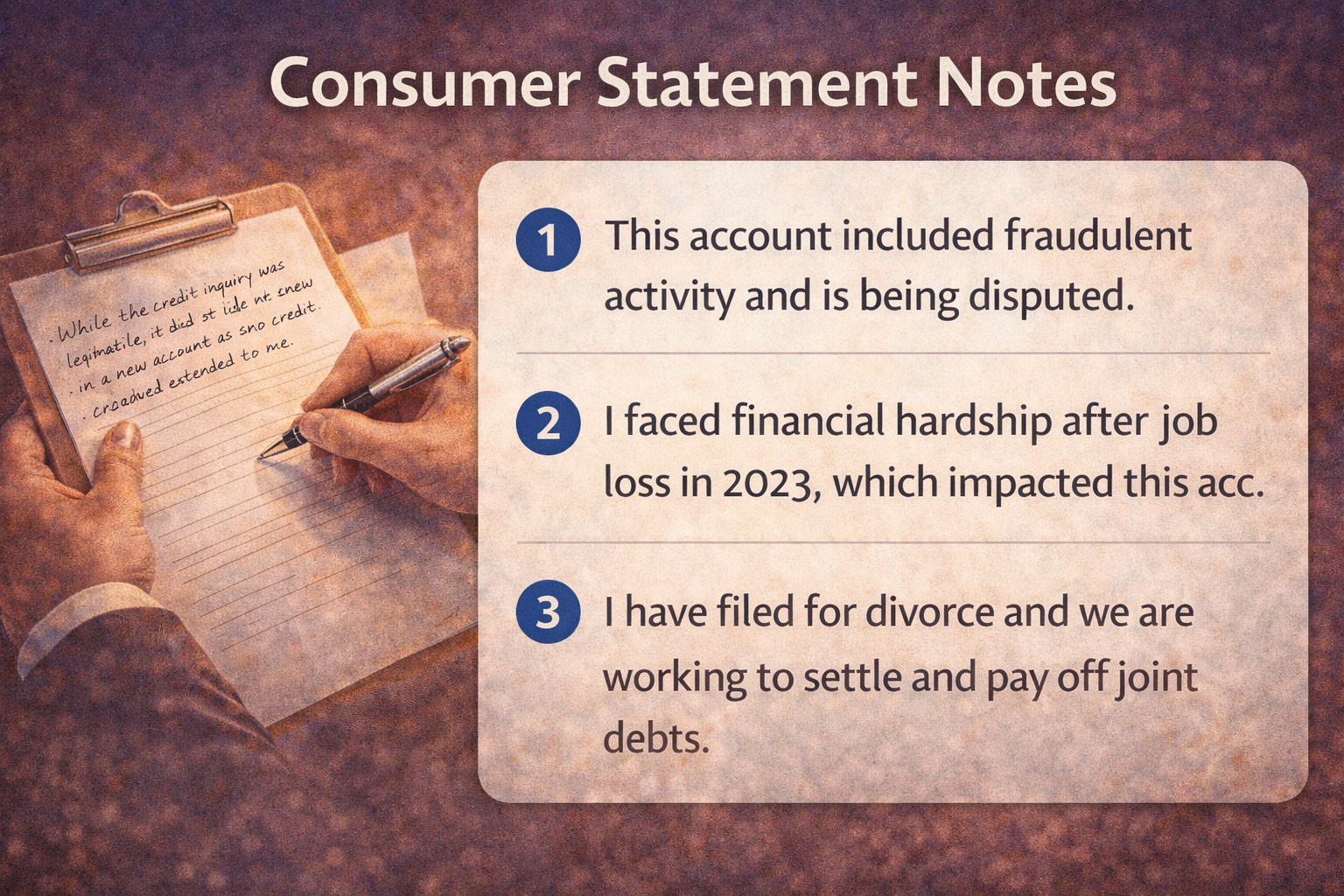
You added a 100-word explanation to your credit report thinking it would help lenders understand that medical emergency or identity theft situation. But what if those consumer statement notes are actually pushing your application into a slower review queue—or worse, raising red flags you never intended? The reality is that most automated lending systems can’t read your explanation at all. They just see that something’s there, and that alone can pull you out of the instant approval track.
Here’s what most people don’t realize: consumer statements don’t affect your credit score, but they can absolutely affect your approval odds and timeline. Whether you’re applying for a mortgage, auto loan, or even a rental property, these statements interact with lending technology in ways that often work against you. The good news? Removing them is possible, and understanding when and how to do it can make your next application process significantly smoother.
How Automated Underwriting Systems Process Consumer Statements
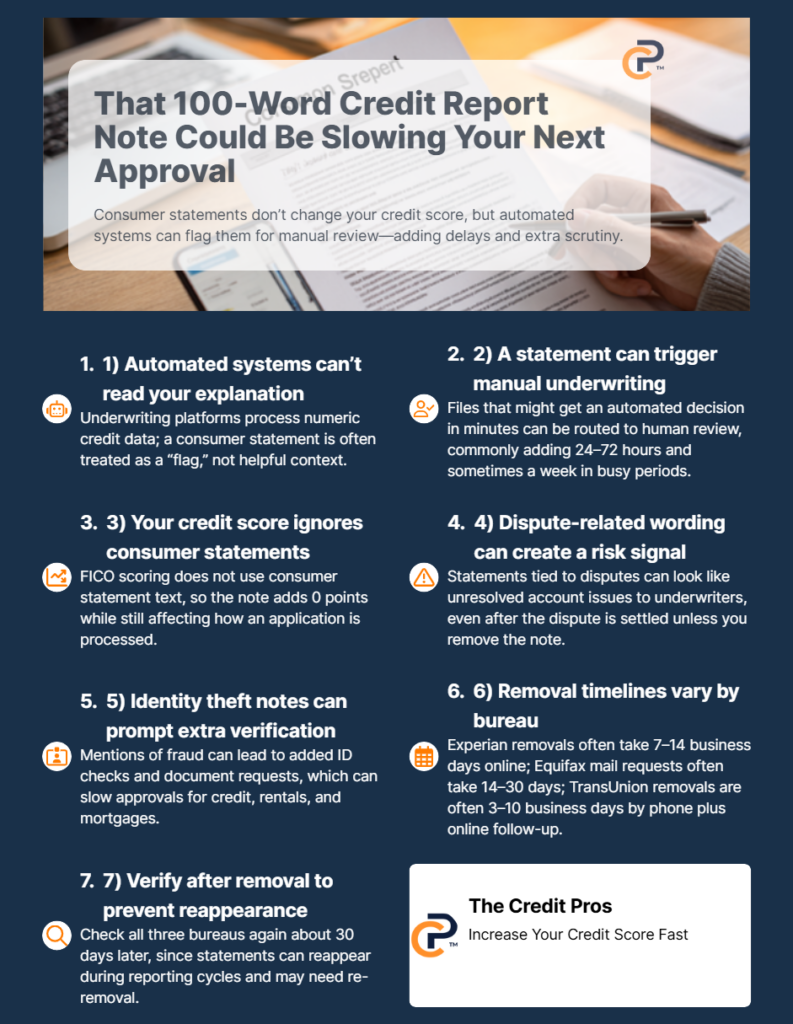
The fundamental disconnect between consumer statements and modern lending technology stems from how automated underwriting systems evaluate credit applications. These systems—including Desktop Underwriter (DU) used by Fannie Mae and Loan Product Advisor (LPA) used by Freddie Mac—operate on algorithmic risk assessment models that process numerical data points, payment patterns, and account statuses. When you add a consumer statement to your credit report, these systems cannot parse the text content of your explanation. The technology simply registers that a statement exists within your credit file, triggering a flag that requires human intervention.
This automation gap creates immediate consequences for application processing speed. Mortgage applications that would normally receive automated approval decisions within minutes instead get routed to manual underwriting queues where human underwriters must review the file. The presence of a consumer statement on credit report files signals to the system that something requires human judgment, even though the automated system cannot determine whether that “something” is significant or trivial. This routing decision adds 24 to 72 hours minimum to approval timelines, and in busy lending periods, the delay can extend to a week or more as applications stack up in manual review queues.
Industry-specific treatment of consumer statements varies dramatically based on regulatory frameworks and risk tolerance. Mortgage underwriters working within Fannie Mae and Freddie Mac guidelines must acknowledge consumer statements and document their consideration in underwriting files, which means they will read your explanation—but this attention brings no guaranteed benefit. Auto lenders using systems like RouteOne or DealerTrack often never see consumer statements at all because their automated decisioning platforms prioritize speed over nuanced review. Credit card issuers typically fall somewhere in between, with prime lenders more likely to review statements during manual underwriting while subprime issuers may approve or deny based solely on algorithmic scoring without ever reading your explanation.
The dispute signal problem compounds the impact of consumer statements because these explanations frequently appear in credit files alongside active dispute notations. When you file a dispute with a creditor or bureau, that dispute flag appears on your tradeline until resolution. Adding a consumer statement that references the same account creates a layered signal of account instability that underwriters interpret as ongoing conflict. Even after a dispute resolves, the consumer statement remains as a permanent reminder of the disagreement unless you actively request removal. This creates a situation where your credit report continues broadcasting a problem that may no longer exist.
The distinction between scoring neutrality and approval impact represents perhaps the most misunderstood aspect of consumer statements. Your FICO score calculation ignores consumer statement text entirely—these explanations contribute zero points positively or negatively to the numerical score that appears on your credit report. However, approval decisions involve far more than credit scores alone. Human underwriters evaluate overall credit profiles, assess risk factors that algorithms might miss, and make judgment calls based on patterns they observe in your credit history. A consumer statement draws direct attention to negative items you’ve chosen to explain, ensuring that underwriters focus on those specific problems rather than evaluating your credit profile holistically. This focused attention on negative history often works against your approval odds, particularly in borderline cases where an underwriter might have overlooked a minor issue if not explicitly highlighted by your own statement.
When Consumer Statements Harm Your Credit Applications
Identity theft explanations create a paradoxical situation where your attempt to clarify fraudulent activity actually raises additional red flags during the underwriting process. When lenders see consumer statements referencing identity theft or fraud, they recognize that your personal information has been compromised at some point. This recognition triggers enhanced identity verification protocols that require additional documentation—utility bills, government-issued identification, employment verification letters, and sometimes even notarized affidavits confirming your identity. These extra verification steps exist because lenders must ensure they’re extending credit to the actual person, not someone using stolen credentials. The irony manifests in how your honest disclosure of past identity theft, intended to explain negative marks, instead creates approval delays and scrutiny that wouldn’t occur if the consumer statement didn’t exist.
Active dispute statements that announce ongoing conflicts with creditors send warning signals that underwriters interpret as potential future payment problems. When your consumer statement includes language like “I am currently disputing this account with the creditor” or “This charge is under investigation,” underwriters see unresolved financial disagreements that could escalate. Lenders view active disputes as indicators that you may stop making payments on other accounts if similar disagreements arise, or that you might dispute the debt they’re about to extend to you. This perception exists regardless of whether your dispute has legitimate grounds—the mere fact of ongoing conflict suggests potential instability that makes you a higher-risk borrower in underwriter eyes.
Hardship narratives that explain past financial difficulties often overshadow the recovery progress you’ve made since those challenges. Consumer statements detailing medical emergencies, divorce proceedings, or job loss provide context for late payments or collections, but they keep negative attention focused on those problems rather than your current financial stability. Underwriters reading these explanations see confirmation of past financial stress, and human psychology tends to weight negative information more heavily than positive information when assessing risk. Even when your credit report shows twelve months of on-time payments following the hardship period, the consumer statement ensures the underwriter spends mental energy evaluating the severity of past problems rather than being impressed by your recovery trajectory.
Goodwill explanation attempts that provide context for late payments guarantee that underwriters will scrutinize those derogatory marks rather than potentially overlooking them in borderline approval scenarios. Credit reports contain numerous data points, and underwriters reviewing files for conventional approval often focus on overall patterns rather than individual late payments, especially if those lates occurred years ago. When you add a consumer statement explaining why you were 30 days late on a credit card in 2023, you’ve essentially highlighted that late payment with a neon marker. Underwriters who might have glanced past a single late payment from two years ago now must read your explanation, re-examine the tradeline, and make a conscious decision about whether that late payment affects your current creditworthiness. This forced attention works against you in situations where the best outcome would be for the underwriter to simply not notice the minor blemish.
The rental application complication presents unique challenges because property management companies use tenant screening services that operate differently from traditional lenders. Companies like RentGrow, CoreLogic, and TransUnion SmartMove generate automated reports that flag consumer statements as warning indicators without the nuanced analysis that mortgage underwriters might provide. Property managers reviewing dozens of applications weekly often use consumer statements as quick screening tools—applications with statements get moved to the “requires additional review” pile while clean applications move forward. These property managers lack the training and regulatory framework that guide mortgage underwriters, so they may interpret any consumer statement as a red flag indicating potential tenant problems. Your explanation of a past medical collection that you’ve since paid in full becomes a reason for concern rather than reassurance in the rental screening context.
How to Remove Consumer Statements from Credit Reports
Experian’s online dispute portal provides the most streamlined approach for consumer statement removal among the three major credit bureaus. You can access the removal request function by logging into your Experian account at experian.com and navigating to the dispute center. The specific language you use in your removal request significantly impacts processing speed and success rates. Rather than simply requesting deletion, frame your request as “I would like to remove the consumer statement I previously added regarding [specific account or topic]” and provide the date you originally added the statement if you remember it. Experian’s system processes online removal requests faster than mail submissions, typically completing the removal within 7 to 14 business days. After submitting your request, monitor your Experian credit report through their website to verify the statement disappears from your file before proceeding with credit applications.
Equifax presents unique challenges because they often require written requests sent to their Consumer Statement Department rather than accepting online removal requests for consumer statements. The mailing address for these requests is Equifax Information Services LLC, P.O. Box 740256, Atlanta, GA 30374-0256. Your written request should include your full name, current address, Social Security number, date of birth, and a clear statement requesting removal of the consumer statement you previously added. Including a copy of your Equifax credit report with the consumer statement highlighted strengthens your request by providing the bureau representative with immediate context. When the underlying issue that prompted your consumer statement has been resolved—such as a dispute that’s now closed or a debt that’s been paid—include documentation proving resolution. Settlement letters, paid-in-full statements, or creditor confirmation letters justify your removal request by demonstrating the explanatory statement no longer serves a purpose. Equifax processing timelines for mailed removal requests typically range from 14 to 30 days, longer than Experian’s online system but still manageable if you plan ahead.
TransUnion offers a hybrid approach that combines phone requests with online follow-up for optimal results. You can call TransUnion’s customer service line at 800-916-8800 and request immediate consumer statement removal. The phone representative can often process removal requests during the call, providing confirmation numbers you should document for your records. Following your phone request, submit a written confirmation through TransUnion’s online dispute center at transunion.com to create a paper trail of your removal request. This dual approach—phone for speed and online for documentation—provides the fastest consumer statement removal among the three bureaus while ensuring you have records proving the request was made. TransUnion typically completes removal within 3 to 10 business days when you use this combined method.
Handling bureau pushback requires understanding your rights under the Fair Credit Reporting Act. When a bureau claims they cannot remove a consumer statement, your response should reference FCRA Section 611(b), which gives you the right to request that consumer statements be removed from your file. The language you use matters: “Under FCRA Section 611(b), I am exercising my right to have the consumer statement I previously submitted removed from my credit file. This is not a dispute of information accuracy but a request to delete a statement I voluntarily added.” If a bureau continues resisting removal, escalate by filing a complaint with the Consumer Financial Protection Bureau at consumerfinance.gov/complaint. CFPB complaints trigger formal bureau responses within 15 days and often resolve removal issues that standard customer service channels cannot address. Document all communication with credit bureaus—save emails, record phone call dates and representative names, and keep copies of mailed correspondence—because this documentation becomes essential if you need to escalate to CFPB intervention.
The 30-day monitoring window after removal requires vigilance because removed consumer statements sometimes reappear during the next reporting cycle. This reappearance occurs when creditors submit updated information to bureaus and the bureau’s system automatically restores previously deleted consumer statements associated with those accounts. To prevent re-insertion, pull updated credit reports from Experian, Equifax, and TransUnion 30 days after your initial removal confirmation. If the consumer statement reappears, immediately contact the bureau using your original removal confirmation number and documentation. State clearly: “I previously requested and received confirmation of consumer statement removal on [date]. The statement has reappeared on my report, and I request immediate re-removal and a flag on my account preventing future re-insertion.” This follow-up verification step ensures your credit file remains clean before you submit applications for mortgages, auto loans, or other credit products.
Better Alternatives to Consumer Statements for Credit Repair
Correcting the underlying reporting error that prompted your consumer statement in the first place represents a far more effective approach than adding explanatory text. Many consumers add statements because they’ve identified inaccurate information on their credit reports—incorrect payment histories, accounts that don’t belong to them, or wrong balance amounts. Rather than explaining these errors through consumer statements, proper dispute resolution through the credit bureau dispute process can remove negative items entirely. When you dispute inaccurate information directly with Experian, Equifax, or TransUnion, the bureaus must investigate within 30 days and either verify the information’s accuracy or delete it from your report. This deletion approach improves your credit profile substantially more than a consumer statement ever could, because the negative item disappears rather than remaining with an attached explanation.
The proper dispute closure sequence eliminates the need for explanatory statements while actually improving your credit standing. When you identify reporting errors, begin by disputing directly with the creditor reporting the information before involving credit bureaus. Creditors must investigate your dispute and respond within specific timeframes under the Fair Credit Reporting Act. If the creditor cannot verify the disputed information’s accuracy, they must request removal from your credit report across all three bureaus. This creditor-first approach often proves more effective than bureau disputes because creditors control the data they report. Once the creditor confirms correction or removal, follow up with each credit bureau to verify the changes appear on your reports. This sequence—creditor dispute, creditor resolution, bureau verification—addresses root causes rather than applying explanatory bandages through consumer statements.
Rapid rescore services available through mortgage lenders provide time-sensitive solutions when you’ve removed consumer statements and resolved underlying issues but need updated credit reports immediately. Traditional credit report updates occur monthly when creditors submit new data to bureaus, meaning corrections can take 30 days to appear on your report. Rapid rescore bypasses this timeline by having your mortgage lender submit documentation directly to credit bureaus proving that negative items have been corrected, paid, or removed. The bureaus then update your credit report within 3 to 5 business days rather than 30 days. This service works particularly well after you’ve removed consumer statements and resolved the underlying issues those statements addressed—you can get a clean, updated credit report in under a week rather than waiting for the next reporting cycle. Rapid rescore typically costs $25 to $40 per account per bureau, and mortgage lenders often cover these costs for borrowers close to qualifying for better loan terms.
Goodwill letter strategy as a replacement for consumer statements achieves better outcomes by requesting creditor action rather than adding explanations. A goodwill letter sent directly to creditors requests voluntary removal of accurate but negative information based on your overall positive payment history and any extenuating circumstances that caused the late payment. Unlike consumer statements that you add to your credit report, goodwill letters ask creditors to stop reporting the negative information entirely. These letters work best when you have a long positive history with the creditor, the late payment was an isolated incident, and you’ve maintained perfect payments since. The success rate for goodwill deletion requests varies by creditor—some major credit card issuers never grant these requests while smaller banks and credit unions show more flexibility—but the potential outcome (complete removal of negative information) far exceeds what consumer statements can achieve (mere explanation of negative information).
Proactive monitoring through credit monitoring services prevents the situations that make consumers feel compelled to add statements in the first place. Services like Credit Karma, Experian’s monitoring, and bank-provided credit monitoring send alerts when new accounts appear, inquiries post, or payment information changes on your credit report. These immediate alerts let you catch reporting errors within days rather than months, allowing you to dispute inaccuracies before they significantly impact your credit score or application outcomes. When you identify a reporting error immediately through monitoring alerts, you can initiate disputes and corrections before ever considering a consumer statement. This proactive approach keeps your credit file clean and accurate without the approval complications that consumer statements create.
The clean file advantage manifests in measurably faster approval timelines even when credit scores remain identical between files with and without consumer statements. Two applicants with 720 FICO scores may receive dramatically different treatment if one has consumer statements and the other doesn’t. The applicant without statements moves through automated underwriting systems, receiving instant approval decisions for credit cards and preliminary approval for mortgages within hours. The applicant with consumer statements gets routed to manual review queues, waiting days for human underwriters to read the explanations and make decisions. This speed difference matters significantly in competitive situations—rental applications where the first qualified applicant gets the property, auto purchases where financing delays cost negotiating leverage, and mortgage approvals where interest rate locks expire if underwriting takes too long. A credit report without consumer statement notes simply processes faster through every type of credit application, providing tangible advantages beyond credit scoring.
Timing Your Consumer Statement Removal Before Credit Applications
The 30-60-90 day planning window for consumer statement removal varies based on the credit product you’re pursuing and the complexity of your credit situation. Mortgage applications require the longest preparation period because mortgage underwriting involves the most thorough credit file review. Removing consumer statements 60 to 90 days before applying for a mortgage allows time for the removal to process across all three bureaus, for you to verify the removal, and for any underlying dispute flags to clear from your tradelines. Auto financing applications require moderate advance planning, with 30 to 60 days providing sufficient time for consumer statement removal and verification before you visit dealerships. Credit card applications present the most flexibility because many card issuers use single-bureau pulls and automated decisioning, meaning you can often remove consumer statements 30 days before applying or even immediately before if you’re using an online application system that pulls your credit report in real-time.
Post-removal verification across all three bureaus represents a critical step that many consumers skip, leading to application complications. Lenders don’t pull credit reports from the same bureau consistently—mortgage lenders typically pull all three bureaus and use the middle score, auto lenders often pull Experian or Equifax, and credit card issuers vary by company. If you remove your consumer statement from Experian but forget to remove it from Equifax and TransUnion, you’ve only solved one-third of the problem. The comprehensive verification approach involves pulling updated credit reports from Experian at experian.com, Equifax at equifax.com, and TransUnion at transunion.com after your removal requests process. Review each report carefully to confirm the consumer statement no longer appears in any section. Some bureaus display consumer statements in multiple locations within credit reports—both in the account-specific section and in a general statements section—so thorough review ensures complete removal.
The dispute flag clearance period extends beyond consumer statement removal because dispute notations attach to specific tradelines and follow different removal timelines. When you dispute an account with a creditor or bureau, that dispute flag remains on the tradeline until the investigation completes and the next reporting cycle occurs. Even after you remove the consumer statement explaining the dispute, the underlying dispute notation may persist for an additional 30 days until the creditor submits updated information to the bureaus. This timing matters because dispute flags trigger their own set of underwriting complications—lenders cannot use disputed tradelines when calculating debt-to-income ratios for mortgage applications, and some automated underwriting systems flag any active disputes as requiring manual
The Bottom Line: Clean Credit Files Move Faster
That explanatory note you added with good intentions doesn’t improve your credit score and actively complicates your approval process by triggering manual review queues that automated systems can’t navigate. While you can’t change past financial difficulties, you can control how prominently they appear during underwriting. Removing consumer statements from Experian, Equifax, and TransUnion takes minimal effort—online requests, phone calls, or simple letters—but the impact on application speed and approval odds proves substantial. The underlying issues that prompted your explanations deserve proper resolution through disputes, creditor negotiations, or goodwill requests rather than permanent explanatory flags that keep negative attention focused on problems you’ve already overcome.
Your credit report tells your financial story, but you get to decide whether that story includes footnotes that slow down every application you submit. The choice between explaining past problems and resolving them represents the difference between applications that process in minutes versus days, between automated approvals and manual scrutiny, between moving forward and staying stuck in review queues. Before your next credit application, ask yourself: does that consumer statement actually help your case, or is it just ensuring that underwriters spend extra time examining the exact issues you’d rather they overlook?