
Credit report errors affect millions of Americans, yet traditional scoring systems often fail to catch obvious mistakes that can tank your credit score for months or even years. While you might spend weeks disputing an error through conventional channels, artificial intelligence is already spotting patterns and inconsistencies that human reviewers consistently miss. This emerging technology is reshaping AI credit scoring accuracy, but how exactly does AI detect these problems faster than existing methods, and what does this mean for your ability to maintain an accurate credit profile?
The answer lies in AI’s unique ability to process vast amounts of credit data simultaneously, cross-referencing information across multiple bureaus and identifying subtle discrepancies that traditional systems overlook. Unlike legacy scoring models that follow rigid rules, AI adapts and learns from each case, becoming more precise at flagging potential errors over time. This evolution not only improves AI credit scoring accuracy but also creates a more fair, transparent, and consumer-friendly scoring system that works in your favor rather than against you.
The Hidden Flaws in Traditional Credit Scoring That AI Exposes
Traditional credit scoring systems operate on rigid algorithmic frameworks that process financial data through predetermined rules, creating significant blind spots that artificial intelligence now illuminates. These legacy systems evaluate creditworthiness using static formulas that cannot adapt to the nuanced realities of individual financial circumstances or detect subtle inconsistencies that indicate reporting errors. As AI credit scoring accuracy improves, these outdated models are increasingly exposed for their inability to identify scoring flaws that AI systems can now detect and flag with precision.

Human oversight in traditional credit monitoring relies heavily on consumer-initiated disputes, placing the burden of error detection on individuals who lack the tools and expertise to identify sophisticated reporting mistakes. This reactive approach allows credit report errors to persist for extended periods, compounding their negative impact on credit scores while consumers remain unaware of the problems. Modern AI-driven credit repair tools enhance AI credit scoring accuracy by continuously scanning credit profiles, detecting anomalies that traditional systems routinely overlook, and identifying errors before they cause long-term damage.
The “data staleness” problem represents one of the most persistent issues in conventional credit reporting, where outdated information remains on credit reports despite technological capabilities that could enable real-time updates. Traditional systems lack the sophisticated cross-referencing ability required to detect conflicting data across multiple bureaus. In contrast, AI credit scoring accuracy benefits from dynamic data mapping, enabling instant recognition of outdated or inconsistent information and providing accuracy maintenance that legacy systems cannot match.
Credit utilization calculations exemplify how traditional scoring models can be distorted by report timing misalignments, where the timing of creditor updates creates artificial spikes or dips in utilization ratios that do not reflect true consumer behavior. These timing-based distortions can significantly affect credit scores without any real change in financial habits, yet legacy systems cannot differentiate between genuine utilization shifts and reporting artifacts. Artificial intelligence solves this issue by analyzing longitudinal behavior patterns, and the continued rise of AI credit scoring accuracy ensures that scoring decisions reflect actual financial behavior—not flawed reporting cycles.
AI’s Pattern Recognition: Identifying Credit Report Inconsistencies Humans Miss
Machine learning algorithms excel at detecting data inconsistencies by processing millions of data points simultaneously across multiple credit bureau reports, identifying patterns that human reviewers cannot perceive due to cognitive limitations and time constraints. These advanced systems create comprehensive data maps that reveal relationships between seemingly unrelated pieces of information, such as account opening dates that precede the consumer’s age of majority or payment histories that conflict with account closure dates. As AI credit scoring accuracy continues to advance, these systems provide real-time detection of anomalies that traditional review processes might take weeks—or never—to uncover.
AI’s pattern recognition capabilities extend to identifying “signature patterns” of data entry errors, such as duplicate accounts with slight variations in account numbers, creditor names, or reporting dates that indicate systematic reporting problems. These sophisticated algorithms learn to recognize the subtle markers that distinguish legitimate account variations from erroneous duplications, such as identical payment patterns across supposedly different accounts or matching credit limits that suggest data copying errors. This improvement in AI credit scoring accuracy ensures that these subtle inconsistencies are identified within seconds rather than relying on slow, manual review processes.
Temporal inconsistencies represent another area where AI demonstrates superior detection capabilities, identifying impossible data combinations such as payments marked as late before an account was opened or credit inquiries recorded before the institution existed. These chronological contradictions often escape human reviewers because traditional credit systems evaluate data points in isolation rather than in sequence. Fintech credit repair platforms use this chronological intelligence—driven by rising AI credit scoring accuracy—to provide powerful dispute evidence that legacy systems cannot produce.
The detection of fraudulent or “phantom” accounts further highlights how AI identifies unusual data clusters that suggest identity theft or reporting errors. Machine learning models analyze statistical probabilities and cross-reference account characteristics to identify combinations that fall outside expected patterns. This capability is especially valuable in detecting synthetic identity fraud, where criminals blend real and fabricated information to build fake profiles. With AI credit scoring accuracy improving continuously, these fraudulent accounts are flagged earlier and with greater precision than ever before.
Bias Elimination: How AI Creates More Equitable Credit Assessments
Algorithmic objectivity in AI credit scoring systems eliminates demographic bias by focusing exclusively on financial behavior patterns without incorporating human preconceptions about creditworthiness based on personal characteristics. Traditional credit assessment often suffers from unconscious bias in human decision-making processes, where factors unrelated to financial capability influence evaluations through subjective interpretation of data. As AI credit scoring accuracy improves, these systems provide a more equitable foundation by analyzing only behavior-based financial indicators rather than personal attributes.
The systematic removal of confirmation bias represents a significant advancement in credit report accuracy, as AI algorithms evaluate each data point independently without being influenced by preexisting assumptions about the consumer’s creditworthiness. Human reviewers often approach disputes with unconscious expectations that shape their interpretation of evidence. Machine learning models eliminate this tendency by treating each data element with equal scrutiny, and the rise in AI credit scoring accuracy ensures conclusions are driven solely by verifiable patterns instead of intuition.
Geographic and institutional biases that disproportionately affect certain consumer populations can also be identified and corrected through AI analysis of historical scoring trends. Traditional scoring models may unintentionally perpetuate regional or institutional disadvantages hidden in legacy datasets. With improvements in AI credit scoring accuracy, dispute systems can detect these systematic inequities by analyzing patterns across demographic groups and adjusting algorithmic weightings to ensure that zip codes, lender types, or regional norms do not unfairly influence credit outcomes.
Algorithmic transparency requirements are pushing modern AI systems to provide clearer explanations for credit score factors than traditional models ever offered. This new level of insight allows consumers to understand precisely which variables influence their credit scores and how targeted financial actions can improve them. The explainable nature of today’s AI models enhances AI credit scoring accuracy while empowering consumers with actionable guidance for optimizing their credit profiles through transparent, data-driven recommendations.
Real-Time Credit Monitoring: AI’s Continuous Accuracy Maintenance
AI-powered credit monitoring systems transform credit oversight from periodic snapshot reviews to continuous, dynamic accuracy verification that provides instant alerts for any changes or potential inaccuracies in credit reports. Traditional credit monitoring relies on monthly or quarterly updates that create significant gaps where errors can impact credit scores without consumer awareness, while AI systems monitor credit profiles continuously and can detect changes within minutes of their occurrence. This continuous monitoring dramatically enhances AI credit scoring accuracy, enabling immediate response to credit report errors before they spread across multiple bureaus.
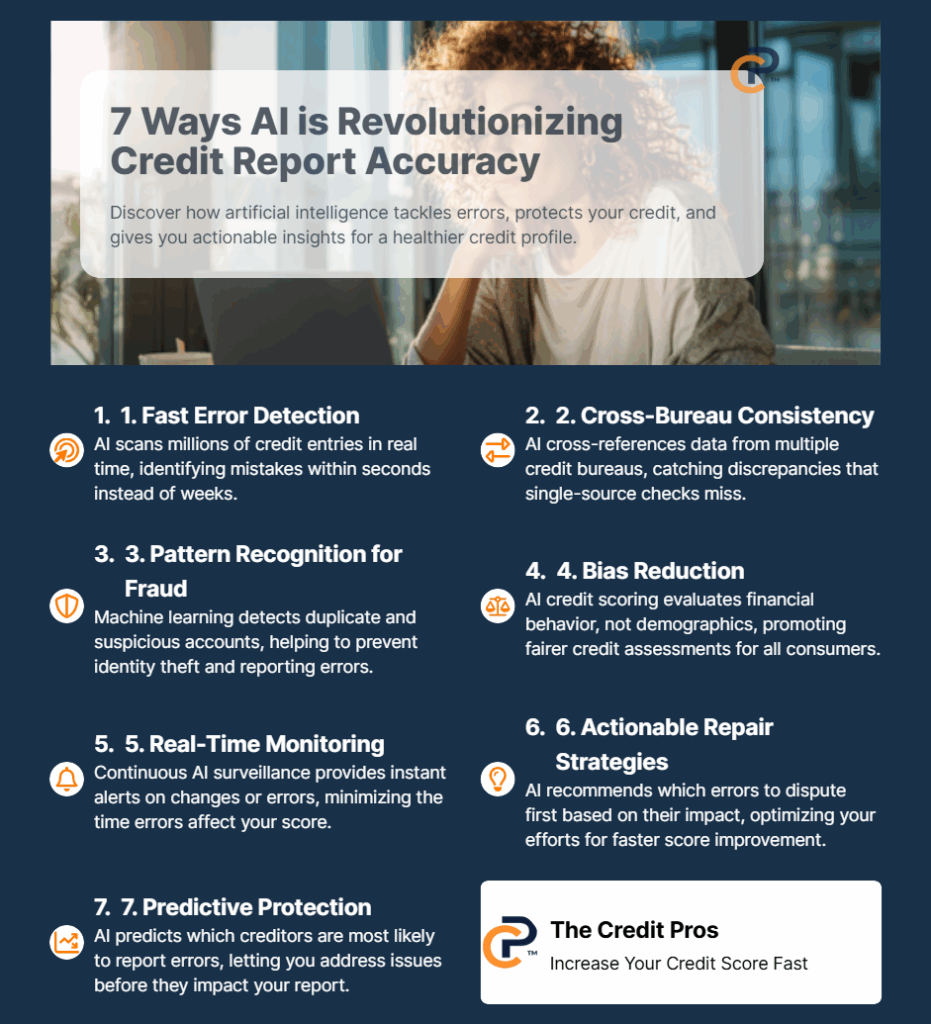
The creation of “credit report fingerprints” through AI analysis enables systems to detect unauthorized changes or suspicious modifications by establishing baseline patterns for each consumer’s credit profile. These digital fingerprints incorporate hundreds of data points including account characteristics, payment patterns, and reporting behaviors to create unique identifiers that can instantly flag deviations from established norms. When changes occur that don’t match expected patterns, AI systems can immediately alert consumers and begin analysis to determine whether the modification is legitimate or requires investigation—further reinforcing AI credit scoring accuracy through pattern-based validation.
Predictive capabilities in AI credit monitoring extend beyond simple change detection to identify potential future credit report errors before they impact scores by analyzing historical patterns in creditor reporting behavior. Machine learning models can predict which types of accounts or creditors are most likely to report errors based on past performance, allowing proactive monitoring of high-risk data sources. This predictive approach not only prevents inaccuracies but also strengthens AI credit scoring accuracy by addressing potential problems before they materialize on consumer credit reports.
The ability to distinguish between legitimate credit changes and potential errors through contextual analysis represents a sophisticated evolution in credit monitoring technology. AI systems analyze the timing, source, and characteristics of credit report changes to assess their legitimacy, considering factors such as:
- Recent consumer financial activity and application history
- Typical reporting patterns for specific creditors or account types
- Consistency with other account information and payment behaviors
- Statistical probability of the reported change based on historical data
- Cross-bureau consistency in reporting similar information
This contextual analysis prevents false alarms while ensuring that genuine errors receive immediate attention, creating a more efficient and effective credit monitoring experience that focuses consumer attention on issues that actually require action.
Actionable Intelligence: How AI Transforms Credit Repair Strategy
AI-driven credit repair strategy optimization analyzes the potential impact of addressing different credit report errors to prioritize actions that will produce maximum score improvement with minimal effort and time investment. Traditional credit repair approaches often address errors in chronological order or based on simple criteria like account balance, without considering the complex interactions between credit factors. By leveraging AI credit scoring accuracy, machine learning algorithms can calculate the precise score impact of correcting specific errors, enabling consumers to focus their efforts on disputes that deliver the most meaningful credit improvements.
The analysis of successful dispute patterns through machine learning creates increasingly effective credit repair strategies by identifying the combination of documentation, timing, and communication approaches that produce the highest success rates. AI systems analyze thousands of resolved disputes to identify the exact behaviors and evidence types that lead to favorable outcomes. This pattern recognition not only increases dispute success but also strengthens AI credit scoring accuracy by clarifying which types of corrections most reliably improve score calculations across different credit bureaus.
Personalized credit improvement recommendations emerge from AI’s ability to compare individual financial conditions with successful credit repair strategies to create tailored action plans aligned with each consumer’s goals. Instead of generic suggestions, AI evaluates current utilization, payment consistency, account age, and long-term objectives. These personalized insights reflect the advancements in AI credit scoring accuracy, ensuring recommendations are based on precise scoring model behavior rather than outdated, one-size-fits-all advice.
The determination of optimal sequencing for addressing multiple credit report errors demonstrates AI’s sophisticated ability to analyze credit scoring mechanics and the complex interactions between different errors. Machine learning models can simulate how fixing one error influences the impact of correcting subsequent ones, allowing consumers to follow strategic timelines that produce stronger cumulative results. This sequencing analysis—powered by advancements in AI credit scoring accuracy—enables credit repair strategies that yield faster, more efficient improvements than traditional methods.
AI also models the compound effects of multiple corrections occurring within short timeframes, predicting how improvements will interact across scoring categories. These predictive insights highlight the growing importance of AI credit scoring accuracy, which allows consumers to understand not only which disputes matter most, but also when and in what order to address them for maximum advantage. By modeling these multidimensional interactions, AI empowers consumers to achieve better credit outcomes in less time.
Conclusion: The Future of Credit Accuracy Is Here
Artificial intelligence has fundamentally transformed credit scoring from a rigid, error-prone system into a dynamic, accurate tool that works in your favor. By eliminating human bias, detecting patterns that traditional systems miss, and providing real-time monitoring with actionable insights, AI doesn’t just make credit scoring more accurate—it makes it more fair. The technology’s ability to spot inconsistencies across millions of data points while creating personalized repair strategies means you’re no longer at the mercy of outdated systems that penalize you for errors you didn’t make.

This shift represents more than technological advancement; it’s a fundamental change in how credit accuracy is maintained and who controls the process. AI empowers you with the tools and intelligence that were previously available only to industry insiders, leveling the playing field between consumers and credit bureaus. As these systems become more sophisticated and widespread, the question isn’t whether AI will improve your credit experience—it’s whether you can afford to rely on outdated methods while others gain the advantage of intelligent credit management.